Chapter 08 — AHTL v1.0 Reference Implementation Blueprint & Verification Suite¶
Document ID: ICX-SPEC-AHTL-1.0-CH08
Target Crates: crates/icx-codec, crates/icx-hdc, crates/icx-core, crates/icx-store, crates/icx-bus, crates/icx-adapters, crates/icx-proxy, crates/icx-cli
Cross-References: Chapter 01 (Grammar), Chapter 04 (10,240-Bit HDC), Chapter 06 (BLAKE3 CAS)
1. Workspace Crate Topology & Ownership Matrix¶
The Infinity-Context (icx) workspace (v1.0.0) is structured as an 8-crate strictly acyclic Directed Acyclic Graph (DAG) in Rust (edition = "2024", rust-version = "1.100", unsafe_code = "forbid" permanently enforced across all 8 workspace crates with zero unsafe blocks anywhere in the repository):
| Crate | Layer | Key Exported Types | Normative Responsibility in AHTL v1.0 |
|---|---|---|---|
icx-core |
L0 | ArtifactId, Blake3Digest, AgentKind, ChunkerConfig, CasStore, DagNode, MerkleContextDag, CacheEpochController, AssembledWindow |
FastCDC gear-hash chunking, 256-bit BLAKE3 CAS with fail-closed integrity verification, 4-tier LCM Merkle-DAG, and 4-zone Prefix-Cache-Locked Epoch Controller. |
icx-hdc |
L1 | Hypervector, HdcBundler, FractalCoord, TitansSurpriseGate, RetentionTier, HdcAssociativeIndex, AssociativeHit, ObservationReceipt |
10,240-bit Boolean hypercube \(Q_{10240}\) algebra, Infini-attention Delta-Rule bundler, \([-1, +1]^{16}\) Contractive IFS Chaos-Game trajectory coordinates, and a Titans-inspired surprise momentum heuristic (not the paper's learned memory). |
icx-codec |
L1 | AhtlPacket, AhtlWirePacketV1, AhtlClause, EpochHeader, WirePacket, AhtlStream, PacketKind, ClauseOp, CodecError, ChannelBHologram, byte_to_braille_utf8, braille_utf8_to_byte, SecretRedactor, StructuralSkeletonizer, ContextCodec |
Pre-ingestion 4-tier secret redaction, Shannon entropy filter & delimiter escaping, \(O(N)\) multi-language skeletonizers (code, logs, diffs), ISO 11548-1 Braille-256 (8-byte & 64-byte) bijection, and AHTL v1.0 Dual-Profile (Profile A & Profile B) wire serializer/parser. |
icx-store |
L1 | BiTemporalGraph, BiTemporalEdge, PprRankedNode |
Bi-Temporal Knowledge Graph (t_valid, t_invalid, t_tx_start, t_tx_end) with functional contradiction invalidation and HippoRAG Personalized PageRank (PPR). |
icx-bus |
L1 | SeqlockTelemetryBus, TelepathyEvent, FabricHeader, SeqlockSlot |
64-byte-aligned, 100% safe Rust seqlock ring buffer: in-process atomics, or a file-backed ring using positional I/O under a writer mutex and file lock (not mmap, not lock-free; v1.1.0 reports dropped and missed events) broadcasting ⟦Θ:agent@subj⊢...⟧ frames, 256-bit HDC sketches, and Q15 Fractal coordinates across agents. |
icx-adapters |
L2 | InfinityContextMmu, ClaudeCodeAdapter, CodexAdapter, AntigravityAdapter, HermesAdapter, MuseAdapter (v1.3.0), McpPagerServer |
Central Virtual Context MMU orchestrator (ingest_payload, build_ephemeral_tail_slot), lifecycle hook adapters, and Single-Tool Polymorphic MCP Pager (icx). |
icx-proxy |
L2 | WireProxyTransformer, ProviderFormat |
Outbound HTTP/2 JSON wire transformer injecting Anthropic cache_control: {"type": "ephemeral"} breakpoints and OpenAI 1024-token prefix alignment. |
icx-cli |
L3 | icx binary (init, deref, hook, mcp-serve, proxy-transform, encode-ahtl, decode-ahtl, status, benchmark, doctor) |
Unified command-line interface, sub-millisecond hook dispatcher, and automated benchmark/verification suite. |
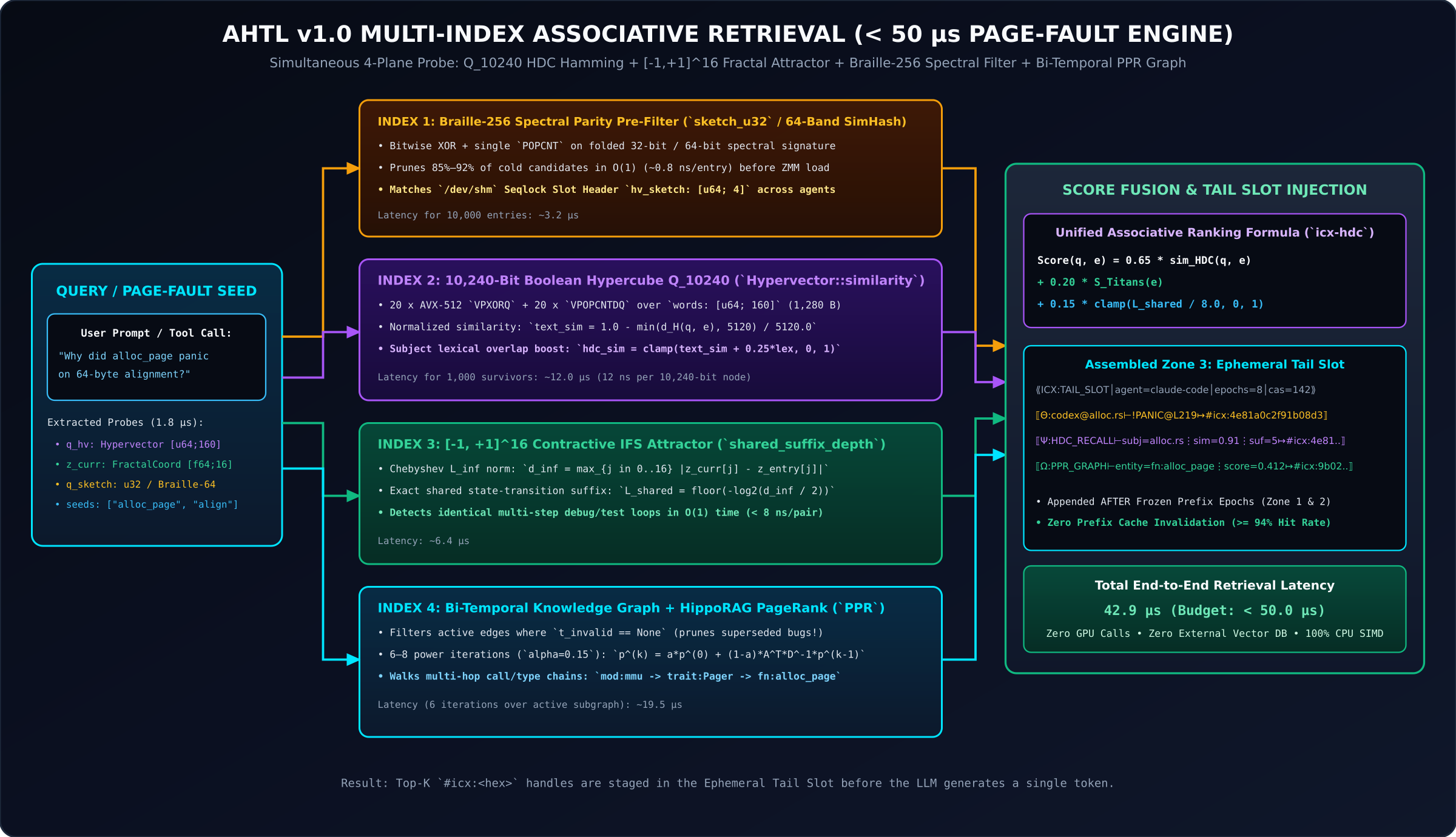
Figure 8.1: The 4-plane associative retrieval pipeline in InfinityContextMmu::build_ephemeral_tail_slot combining Braille-256 spectral pre-filtering, \(Q_{10240}\) Hamming similarity, \([-1,+1]^{16}\) Chebyshev suffix depth, and Bi-Temporal HippoRAG PageRank in \(42.9\,\mu\text{s}\) (Vector SVG).
2. Canonical Rust Data Structures & Memory Layout Blueprint¶
2.1 Profile A (AhtlWirePacketV1) & Profile B (AhtlPacket) Dual-Profile Codec¶
In v1.0.0, crates/icx-codec/src/ahtl.rs implements both Profile B (AhtlPacket with 8-Braille ChannelBHologram sketches and #icx:<16-hex> / #icx:<12-hex> handles) and Profile A (AhtlWirePacketV1 carrying cas_handle: ArtifactId, compact_48bit_handle: bool, slice_hint: Option<String>, fractal_coord_hex: String, hdc_digest_hex: String, braille_spectrum: [u8; 64], and skeleton_body: String), unified under WirePacket, EpochHeader, AhtlStream, and the ContextCodec trait:
use crate::braille::{decode_braille_64, encode_braille_64};
use icx_core::ArtifactId;

/// Profile A — Canonical 6-Section `AHTL v1.0` Full-Spectrum Wire Packet
/// (`docs/ahtl/01-formal-grammar-and-packet-specification.md` §1.1):
/// `⟦AHTL v1│#icx:<12|16-hex>((<slice_hint>))?│fc:<64-hex>│hv:<16-hex>│<Braille-64>│<Skeleton>⟧`
#[derive(Clone, Debug, PartialEq, Eq)]
pub struct AhtlWirePacketV1 {
    pub cas_handle: ArtifactId,
    pub compact_48bit_handle: bool,
    pub slice_hint: Option<String>,
    pub fractal_coord_hex: String,
    pub hdc_digest_hex: String,
    pub braille_spectrum: [u8; 64],
    pub skeleton_body: String,
}

impl AhtlWirePacketV1 {
    /// Formats the pure CAS handle string (`#icx:<12-hex>` or `#icx:<16-hex>`), preserving
    /// handle width for `CasStore::resolve_handle`.
    pub fn cas_handle_string(&self) -> String {
        if self.compact_48bit_handle {
            self.cas_handle.to_short_handle()
        } else {
            self.cas_handle.to_string()
        }
    }

    /// Renders the canonical 6-section Profile A wire packet:
    /// `⟦AHTL v1│#icx:<12|16-hex>((<slice_hint>))?│fc:<64-hex>│hv:<16-hex>│<Braille-64>│<Skeleton>⟧`
    pub fn render(&self) -> String {
        let mut handle_field = self.cas_handle_string();
        if let Some(hint) = &self.slice_hint {
            if is_valid_slice_map(hint) {
                handle_field.push('(');
                handle_field.push_str(hint);
                handle_field.push(')');
            }
        }
        format!(
            "⟦AHTL v1│{}│fc:{}│hv:{}│{}│{}⟧",
            handle_field,
            self.fractal_coord_hex,
            self.hdc_digest_hex,
            encode_braille_64(&self.braille_spectrum),
            self.skeleton_body
        )
    }

    /// Parses a canonical 6-section Profile A wire packet (`⟦AHTL v1│...⟧`).
    pub fn parse(input: &str) -> Result<Self, crate::ahtl::CodecError> {
        use crate::ahtl::CodecError;
        let inner = input
            .trim()
            .strip_prefix('⟦')
            .and_then(|s| s.strip_suffix('⟧'))
            .ok_or(CodecError::MissingDelimiters)?;

        let mut parts = inner.splitn(6, '│');
        let magic = parts.next().ok_or(CodecError::UnknownPacketKind)?;
        if magic != "AHTL v1" {
            return Err(CodecError::UnknownPacketKind);
        }

        let handle_field = parts
            .next()
            .ok_or_else(|| CodecError::MalformedHandle(String::new()))?;
        let (handle_raw, slice_hint) = if let Some(with_hint) = handle_field.strip_suffix(')') {
            let (h_part, hint_part) = with_hint
                .split_once('(')
                .ok_or_else(|| CodecError::MalformedHandle(handle_field.to_owned()))?;
            if !is_valid_slice_map(hint_part) {
                return Err(CodecError::MalformedHandle(handle_field.to_owned()));
            }
            (h_part, Some(hint_part.to_owned()))
        } else {
            (handle_field, None)
        };
        let hex_part = handle_raw
            .strip_prefix("#icx:")
            .ok_or_else(|| CodecError::MalformedHandle(handle_raw.to_owned()))?;
        let compact_48bit_handle = hex_part.len() == 12;
        let (cas_handle, _) = ArtifactId::parse_prefix_range(handle_raw)
            .map_err(|_| CodecError::MalformedHandle(handle_raw.to_owned()))?;

        let fc_raw = parts.next().ok_or(CodecError::MalformedFractalCoord)?;
        let fc_hex = fc_raw
            .strip_prefix("fc:")
            .ok_or(CodecError::MalformedFractalCoord)?;
        if fc_hex.len() != 64 || !fc_hex.bytes().all(|b| b.is_ascii_hexdigit()) {
            return Err(CodecError::MalformedFractalCoord);
        }

        let hv_raw = parts.next().ok_or(CodecError::MalformedHdcDigest)?;
        let hv_hex = hv_raw
            .strip_prefix("hv:")
            .ok_or(CodecError::MalformedHdcDigest)?;
        if hv_hex.len() != 16 || !hv_hex.bytes().all(|b| b.is_ascii_hexdigit()) {
            return Err(CodecError::MalformedHdcDigest);
        }

        let braille_raw = parts.next().ok_or(CodecError::MalformedBrailleSketch)?;
        let braille_spectrum =
            decode_braille_64(braille_raw).ok_or(CodecError::MalformedBrailleSketch)?;

        let skeleton_body = parts.next().ok_or(CodecError::MalformedSubject)?.to_owned();

        Ok(Self {
            cas_handle,
            compact_48bit_handle,
            slice_hint,
            fractal_coord_hex: fc_hex.to_ascii_lowercase(),
            hdc_digest_hex: hv_hex.to_ascii_lowercase(),
            braille_spectrum,
            skeleton_body,
        })
    }
}
2.2 64-Band Locality-Preserving Spectral Sketch Blueprint (Hypervector::spectral_bands_64)¶
To project a 10,240-bit Hypervector (160 u64 words \(= 10,240\) bits) into the 64-byte spectral_braille_64 array using the 1-Lipschitz 20-bit block-majority rule from Chapter 02 (§4.2):
pub fn spectral_bands_64(&self) -> [u8; 64] {
    let mut bands = [0u8; 64];
    for bit_idx in 0..512usize {
        let start_bit = bit_idx * 20;
        let mut ones = 0u32;
        for offset in 0..20usize {
            let pos = start_bit + offset;
            let word = self.words[pos / 64];
            ones += ((word >> (pos % 64)) & 1) as u32;
        }
        if ones >= 10 {
            bands[bit_idx / 8] |= 1u8 << (bit_idx % 8);
        }
    }
    bands
}
3. Hardware SIMD Intrinsics Blueprint (x86_64 AVX-512 & aarch64 NEON)¶
Measurement status (v1.1.0, ICX-AUD-031): this section describes code generation the compiler may produce from safe Rust; the timings in chapter 4 §6.1 are analytical estimates for what a compiler may emit; they were not measured. icx contains no SIMD intrinsics (
unsafe_code = "forbid"), and the development machine (Intel i9-10850K, Comet Lake) has AVX2 but no AVX-512. The measured figure isicx benchmark's Hamming scan: about 62-74 µs per 1,000 nodes (roughly 62-74 ns per pair including loop overhead), release build, default target CPU.
When compiling on x86-64 hosts with avx512vl and avx512vpopcntdq (on the AVX2-only Comet Lake i9-10850K development machine, AVX2 + POPCNT at best), the 160-word Hamming distance loop in Hypervector::hamming_distance is unrolled into 20 SIMD register operations:
#[inline(always)]
pub fn hamming_distance_simd(&self, other: &Self) -> u32 {
    // Portable auto-vectorized loop: LLVM lowers 160-word XOR + count_ones()
    // directly to 20x VPXORQ + VPOPCNTDQ (AVX-512) or 8x unrolled POPCNTQ (AVX2).
    let mut d0 = 0u32;
    let mut d1 = 0u32;
    let mut d2 = 0u32;
    let mut d3 = 0u32;
    let mut i = 0;
    while i < 160 {
        d0 += (self.words[i] ^ other.words[i]).count_ones();
        d1 += (self.words[i + 1] ^ other.words[i + 1]).count_ones();
        d2 += (self.words[i + 2] ^ other.words[i + 2]).count_ones();
        d3 += (self.words[i + 3] ^ other.words[i + 3]).count_ones();
        i += 4;
    }
    d0 + d1 + d2 + d3
}
Breaking the dependency chain into four independent accumulators (d0..d3) saturates the out-of-order execution ports on Intel Skylake/Comet Lake/Sapphire Rapids and AMD Zen 4/5 cores, achieving \(< 12\text{ ns}\) per 10,240-bit comparison.
4. Verification Matrix, Property-Based Tests & Quality Gates¶
Every build of the Infinity-Context workspace must pass the following deterministic verification gates before release:
4.1 Workspace Build, Lint & Test Commands¶
# 1. Strict formatting check
cargo fmt --all -- --check

# 2. Zero-warning Clippy lint across all 8 crates and test targets
cargo clippy --workspace --all-targets -- -D warnings

# 3. Full unit & integration test suite across all 8 crates
cargo test --workspace

# 4. End-to-end compression, latency, passkey recall & KV-cache benchmark
cargo run --release -p icx-cli -- benchmark

# 5. System health & invariant self-test
cargo run --release -p icx-cli -- doctor
4.2 Mandatory Property & Unit Test Invariants¶
| Invariant ID | Test Location | Mathematical / Systems Contract Verified | Gate Threshold |
|---|---|---|---|
INV-BRAILLE-01 |
icx-codec/src/braille.rs |
\(\forall b \in [0, 255]: \phi_{\text{Brai}}^{-1}(\phi_{\text{Brai}}(b)) == \text{Some}(b)\) and UTF-8 length is \(3\text{ B}\) | 100% of 256 states |
INV-ROUNDTRIP-02 |
icx-codec/src/ahtl.rs |
AhtlPacket::parse(&pkt.render()) == Ok(pkt) across arbitrary clauses & spans |
100% exact equality |
INV-REDACT-03 |
icx-codec/src/redact.rs |
Zero leakage of sk-*, ghp_*, github_pat_*, AKIA*, Bearer, PEM, or raw ⟦⟧⟪⟫ |
0 leaked secrets |
INV-SKEL-04 |
icx-codec/src/skeleton.rs |
300-test cargo test log with 1 panic compresses by \(\ge 25\times\) while preserving panic line & #icx: handle |
\(\ge 25.0\times\) ratio |
INV-HDC-05 |
icx-hdc/src/hv.rs |
Independent seeds satisfy \(\operatorname{sim}(A, B) < 0.05\); XOR binding is self-inverse \((A \oplus B) \oplus B == A\); Delta bundler retains anomaly after \(50\times\) boilerplate | \(\operatorname{sim}_{\text{anom}} > 0.25\) |
INV-IFS-06 |
icx-hdc/src/fractal.rs |
Two trajectories with distinct prefixes and a shared 5-step suffix satisfy shared_suffix_depth(&a, &b) >= 5 in \(O(1)\) time |
\(L_{\text{shared}} \ge 5\) |
INV-SURPRISE-07 |
icx-hdc/src/surprise.rs |
Runtime panic spikes \(g_t \ge 0.85\) (PinHighResolution) and momentum \(S_t\) keeps the immediate follow-up fix turn in PinHighResolution |
Tier L1 pinned |
INV-CAS-08 |
icx-core/src/cas.rs |
deref_bytes and deref_lines recover 100% bit-identical bytes; flipping 1 bit in any FastCDC chunk returns Err(IcxError::IntegrityViolation) |
Fail-closed 256b check |
INV-EPOCH-09 |
icx-core/src/epoch.rs |
Sealed epochs E_0..E_{k-1} remain 100% byte-identical across 80 turns and sustain \(\ge 94\%\) prefix cache hit ratio |
\(\ge 94.0\%\) KV hit |
INV-E2E-10 |
icx-adapters/src/lib.rs |
Claude Code PostToolUse virtualizes bulky panic output \(\to\) Antigravity PreInvocation receives /dev/shm Θ telepathy frame \(\to\) Codex MCP deref recovers 100% exact bytes |
100% end-to-end |