Chapter 06 — BLAKE3 Merkle-DAG Content-Addressed Storage & #icx:<hex> Virtual Handles
Document ID: ICX-SPEC-AHTL-1.0-CH06
Target Crates: crates/icx-core/src/lib.rs, crates/icx-core/src/chunker.rs, crates/icx-core/src/cas.rs, crates/icx-core/src/dag.rs, crates/icx-adapters/src/mcp.rs
Primary Archival References: ref-docs/blake3-cryptographic-hash/README.md · BLAKE3_Official_Specification.pdf · docs/virtual-memory-and-dag-engine.md
1. Overview: Lossless Virtual Memory via Content-Addressed Merkle Trees
The foundational guarantee of Infinity-Context (icx) is 100% Lossless Context Management (LCM, arXiv:2605.04050) over sanitized artifacts: compressing a 30 KB compiler log or source file into a 39-token AHTL v1.0 stub never discards a single byte of the post-redaction (SecretRedactor::sanitize) artifact. Every AHTL packet embeds a cryptographic virtual memory pointer (#icx:<16-hex>, or #icx:<12-hex> in the Phase 1 Sprint 1.1 extension) that resolves deterministically in CasStore to the exact sanitized byte stream or 1-based line slice in \(< 50\,\mu\text{s}\).
To achieve multi-gigabyte-per-second ingestion throughput with sub-file deduplication and fail-closed tamper detection, icx-core combines:
- Gear-Hash Content-Defined Chunking (
FastCDC) to split large artifacts along content-determined boundaries (2 KiB..64 KiB). - The
BLAKE3Cryptographic Hash Function (7-round ChaCha ARX permutation over a 1,024-byte Left-Full binary Merkle tree) to seal every chunk, artifact, turn, folded branch, and cache epoch. - The Single-Tool Polymorphic MCP Pager (
McpPagerServer) to exposederef,slice,grep,recall,fold,xagent, andstatusbehind a single< 180 tokentool schema.
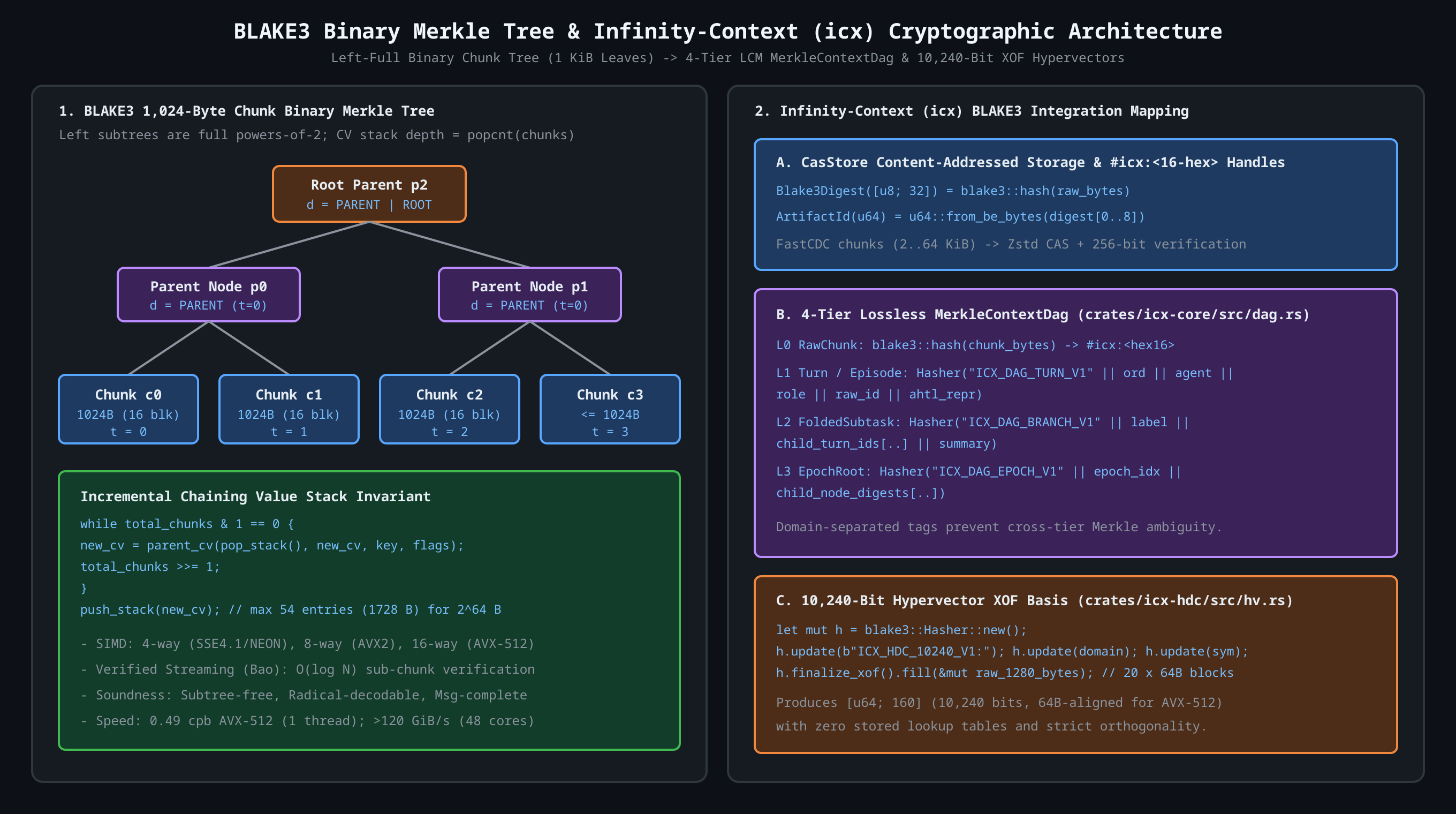
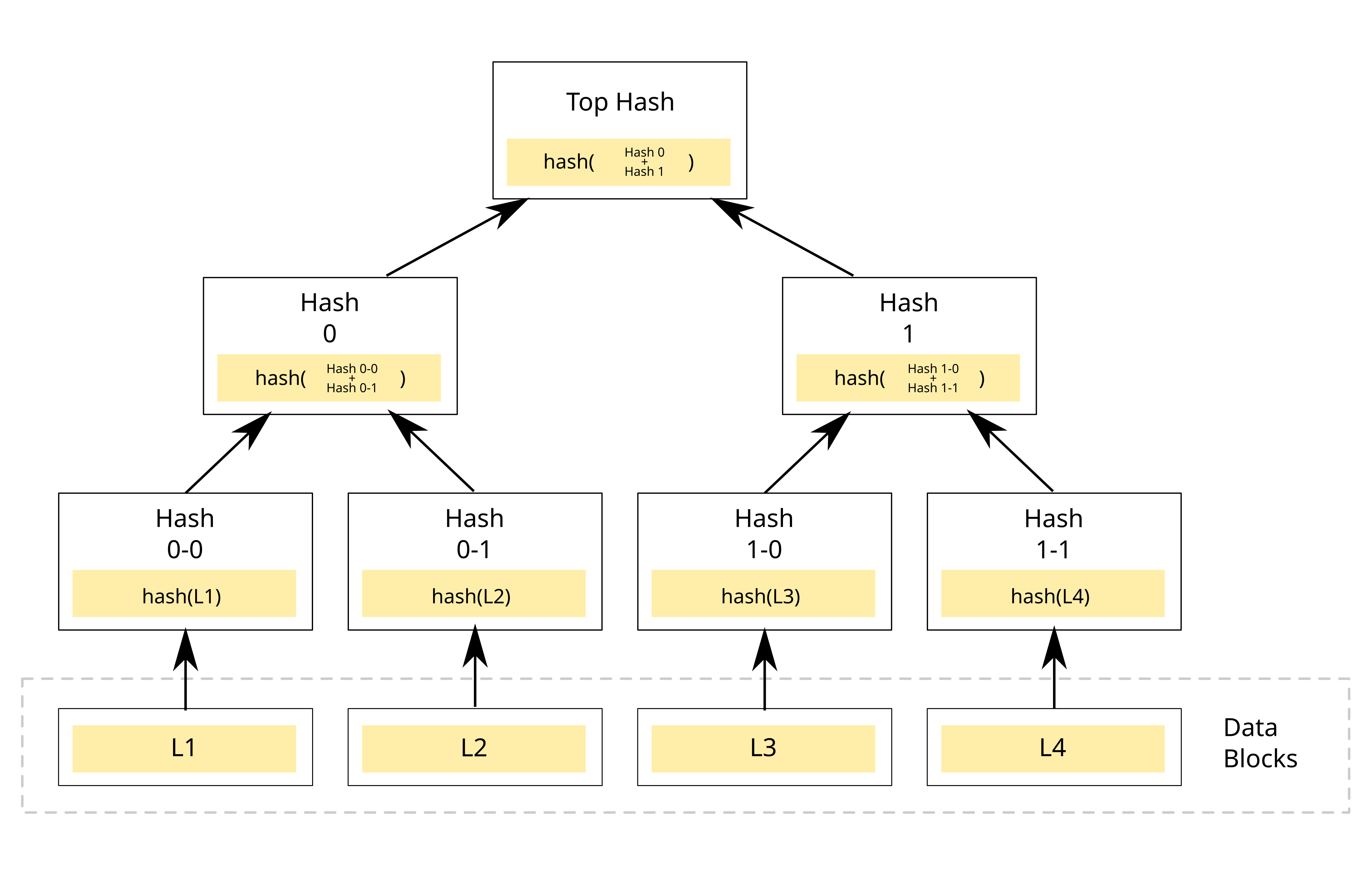
Figure 6.1: BLAKE3 1,024-byte Left-Full binary Merkle tree topology (CV stack) and its architectural mapping onto icx-core (CasStore, 4-tier MerkleContextDag, and 10,240-bit XOF Hypervector) (Vector SVG).
2. Gear-Hash Content-Defined Chunking (FastCDC in crates/icx-core/src/chunker.rs)
When an agent repeatedly reads or edits a large file across turns, fixed-offset block chunking (e.g., splitting every \(8,192\) bytes) suffers from the boundary-shift problem: inserting 17 bytes at the top of a file shifts every subsequent block boundary, invalidating 100% of cached chunk hashes.
icx-core solves this via Gear-Hash Content-Defined Chunking (FastCDC) (crates/icx-core/src/chunker.rs:21-79):
2.1 Deterministic SplitMix64 Gear Table Generation
At compile time (const fn build_gear_table), a 256-entry table GEAR_TABLE: [u64; 256] is synthesized from the 64-bit ASCII seed 0x4943_585F_4641_5354 ("ICX_FAST"):
2.2 Rolling Gear Fingerprint & Cut-Point Condition
Given ChunkerConfig { min_size: 2048, avg_size: 8192, max_size: 65536 }, let \(k = \lfloor \log_2(\text{avg\_size}) \rfloor = 13\), with Normalized FastCDC stricter mask \(\text{mask}_S = 2^{k+1} - 1 = \text{0x3FFF}\) before avg_size and relaxed mask \(\text{mask}_L = 2^{k-1} - 1 = \text{0x0FFF}\) from avg_size to max_size. Starting from chunk start offset \(p_0\), the scanner skips the minimum window \([p_0, p_0 + \text{min\_size})\) and then updates the 64-bit rolling fingerprint fp at each byte \(B[p]\) in \([p_0 + \text{min\_size}, \min(N, p_0 + \text{max\_size}))\):
A chunk boundary is declared immediately after index \(p\) when:
Because the 1-bit left shift \(\text{fp} \ll 1\) ages out bytes older than 64 positions (\(2^{64} \equiv 0 \pmod{2^{64}}\)), any insertion or edit in a file perturbs at most 1–2 local chunks, after which FastCDC re-synchronizes to the exact same cut points!
3. BLAKE3 Cryptographic Engine: ARX Quarter-Round, Bao Merkle Tree & Domain Flags
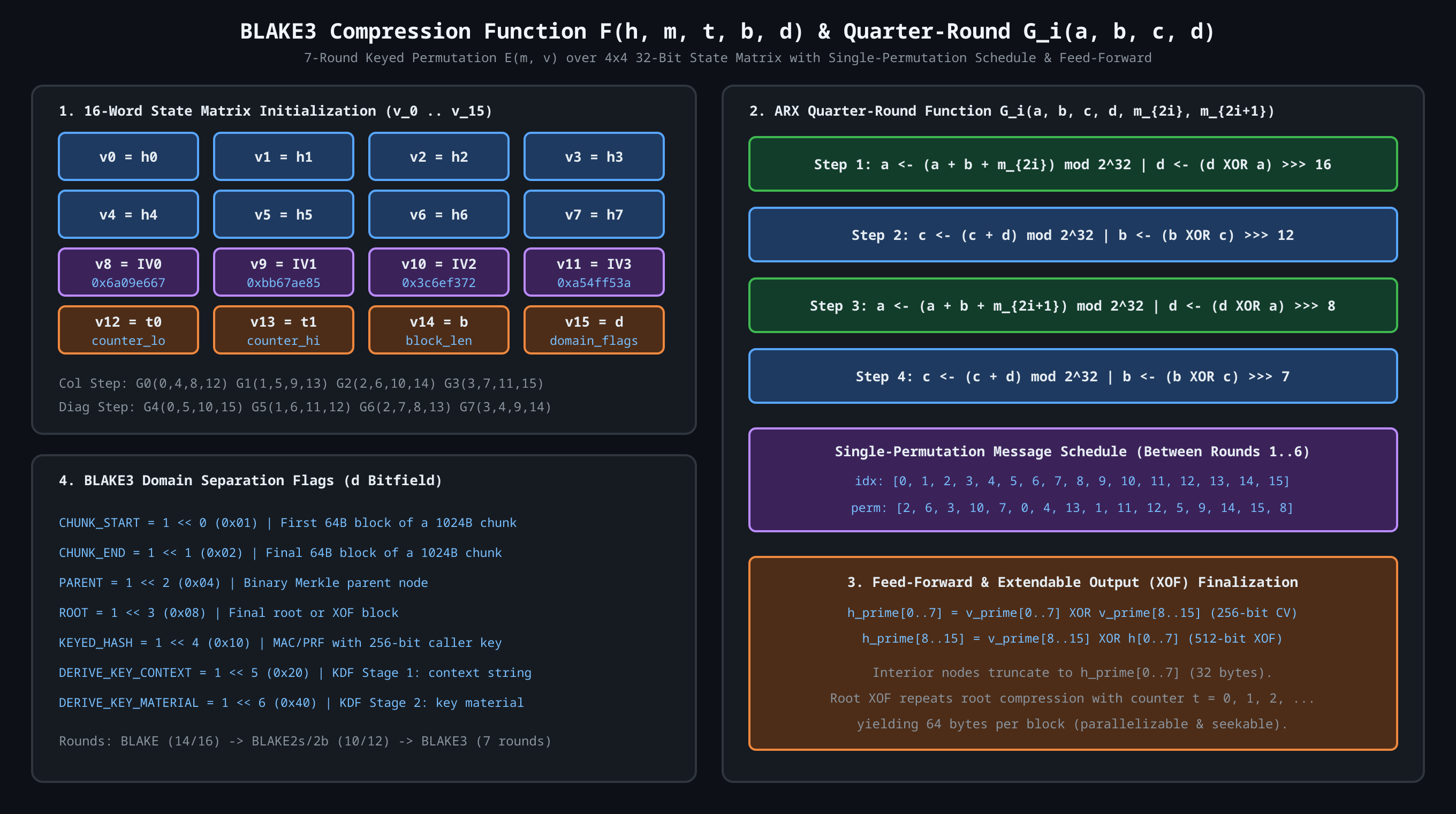
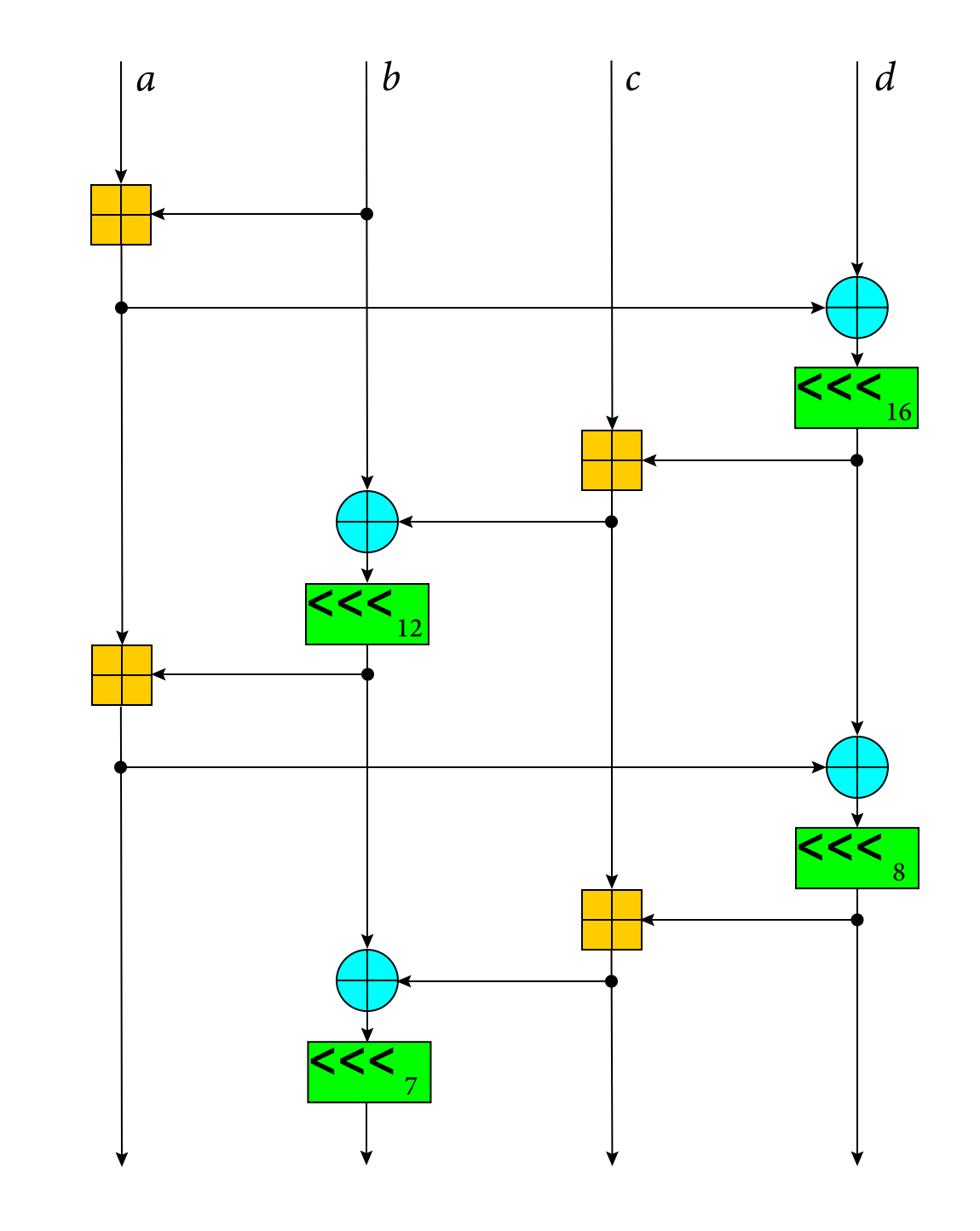
Figure 6.2: The 7-round BLAKE3 compression function \(F(h, m, t, b, d)\), \(G_i(a,b,c,d)\) ChaCha ARX quarter-round, single-permutation schedule, and domain flags (Vector SVG).
ChaCha / BLAKE3 ARX Quarter-Round (ChaCha20_Quarter_Round.png) |
Binary Merkle Hash Tree Topology (BLAKE3_Merkle_Tree_Bao.png) |
|---|---|
 |
 |
3.1 The 7-Round Compression Function \(F(h, m, t, b, d)\)
Every 64-byte block in BLAKE3 initializes a \(4 \times 4\) matrix of 32-bit little-endian words \(v_0 \dots v_{15}\) from the 8-word chaining value \(h_0 \dots h_7\), the first four SHA-256/BLAKE2s IV words (\(\text{IV}_{0..3} = \text{0x6a09e667}, \text{0xbb67ae85}, \text{0x3c6ef372}, \text{0xa54ff53a}\)), the 64-bit chunk/XOF counter \((t_0, t_1)\), the block byte length \(b \in [0, 64]\), and the domain bitmask \(d\):
Each of the 7 rounds executes 4 parallel column quarter-rounds \(G_0 \dots G_3\) followed by 4 parallel diagonal quarter-rounds \(G_4 \dots G_7\) with right-rotation constants \((16, 12, 8, 7)\), permuting the 16 message words \(m_0 \dots m_{15}\) between rounds via the fixed permutation \(\pi = [2, 6, 3, 10, 7, 0, 4, 13, 1, 11, 12, 5, 9, 14, 15, 8]\).
3.2 Domain Separation Flags (d) & 4-Tier MerkleContextDag Tags
In addition to BLAKE3's internal hardware flags (CHUNK_START = 0x01, CHUNK_END = 0x02, PARENT = 0x04, ROOT = 0x08, KEYED_HASH = 0x10, DERIVE_KEY_CONTEXT = 0x20, DERIVE_KEY_MATERIAL = 0x40), icx enforces explicit application-level domain separation prefixes across all four tiers of MerkleContextDag (crates/icx-core/src/dag.rs) and Hypervector generation so that no two tiers can ever produce a cross-type Merkle collision:
| Subsystem / Tier | Domain Prefix String | Hashed Fields | Output Type |
|---|---|---|---|
L0 Raw Chunk & Artifact (CasStore) |
(Raw byte stream) | blake3::hash(raw_bytes) |
(ArtifactId, Blake3Digest) |
L1 Turn / Episode (DagNode::Turn) |
b"ICX_DAG_TURN_V1" |
ordinal_be8 \|\| [agent_u8] \|\| role_len_be8 \|\| role \|\| raw_id_be8 \|\| ahtl_len_be8 \|\| ahtl_repr \|\| surprise_be4 \|\| tok_est_be8 |
DagNode::Turn (ArtifactId) |
L1 Tool Artifact (DagNode::ToolArtifact) |
b"ICX_DAG_TOOL_V1" |
raw_id_be8 \|\| full_digest_32B \|\| [agent_u8] \|\| session_id \|\| tool_name \|\| exit_code \|\| totals \|\| chunks[..] \|\| line_index[..] \|\| ahtl_stub \|\| surprise_be4 \|\| created_at_ms \|\| tok_est_be8 |
DagNode::ToolArtifact (ArtifactId) |
L2 Folded Branch (SubTrajectoryBranch) |
b"ICX_DAG_BRANCH_V1" |
label_len_be8 \|\| label \|\| count_be8 \|\| (child_id_be8 \|\| child_digest_32B)[..] \|\| summary_len_be8 \|\| outcome_summary |
DagNode::SubTrajectoryBranch |
L3 Sealed Cache Epoch (CacheEpoch) |
b"ICX_DAG_EPOCH_V1" |
epoch_index_be4 \|\| child_count_be8 \|\| raw_tokens_be8 \|\| (child_digest_32B \|\| pkt_len_be8 \|\| pkt_bytes)[..] |
DagNode::CacheEpoch |
L4 Folded Cache Epoch (CacheEpoch) |
b"ICX_DAG_EPOCH_FOLD_V1" |
first_epoch_index_be4 \|\| epoch_count_be8 \|\| child_epoch_roots_32B[..] |
DagNode::CacheEpoch |
Q_10240 HDC Basis (Hypervector) |
b"ICX_HDC_10240_V1:" |
domain \|\| b"::" \|\| symbol \(\to\) finalize_xof() (1,280 B) |
Hypervector([u64; 160]) |
4. Virtual Memory Handle Resolution (#icx:<hex12> & #icx:<hex16>) & Collision Analysis
4.1 Handle Formats & Prefix Resolution
An ArtifactId (crates/icx-core/src/lib.rs) extracts the leading big-endian bits of a 256-bit Blake3Digest:
- Profile B & Active Interoperable u64 Key (#icx:<16-hex>, 64 bits): u64::from_be_bytes(digest[0..8]), formatted as #icx:{:016x} (21 ASCII characters), active across crates/icx-core/src/lib.rs, crates/icx-codec/src/ahtl.rs, and crates/icx-adapters/src/mcp.rs.
- Profile A Compact Handle (#icx:<12-hex>, 48 bits — Implemented via CasStore::resolve_handle): The top 48 bits (digest[0..6], formatted as #icx:{:012x}, 17 ASCII characters), parsed via ArtifactId::parse_prefix_range and resolved in \(O(\log N)\) time by CasStore::resolve_handle (and McpPagerServer) using BTreeMap::range(prefix_min..=prefix_max) over CasStore::artifacts.
- Normative Prefix-Collision & Ambiguity Rule: When resolving a 48-bit #icx:<12-hex> prefix over BTreeMap::range(prefix_min..=prefix_max), if more than one stored ArtifactId falls within [prefix_min, prefix_max], lookup must fail closed with Err(IcxError::AmbiguousHandlePrefix) rather than selecting an arbitrary match, requiring the caller to disambiguate with the full 64-bit #icx:<16-hex> handle.
4.2 Birthday-Bound Collision Analysis & Full-256-Bit Verification Gate
For a \(B\)-bit handle space across \(N\) distinct artifacts in a session or workspace, the birthday-bound collision probability is:
| Handle Width (\(B\)) | Wire Format | \(N = 10^4\) Artifacts | \(N = 10^5\) Artifacts | \(N = 10^6\) Artifacts | Verification Gate on Dereference |
|---|---|---|---|---|---|
| \(B = 48\text{ bits}\) | #icx:<12-hex> (Profile A) |
\(1.78 \times 10^{-7}\) | \(1.78 \times 10^{-5}\) | \(1.78 \times 10^{-3}\) | Prefix range check + Full 256-bit Blake3Digest verification |
| \(B = 64\text{ bits}\) | #icx:<16-hex> (ArtifactId) |
\(2.71 \times 10^{-12}\) | \(2.71 \times 10^{-10}\) | \(2.71 \times 10^{-8}\) | Direct u64 key + Full 256-bit Blake3Digest verification |
| \(B = 128\text{ bits}\) | IcxHandle (Cluster Wire) |
\(1.47 \times 10^{-31}\) | \(1.47 \times 10^{-29}\) | \(1.47 \times 10^{-27}\) | Full 256-bit Blake3Digest verification |
| \(B = 256\text{ bits}\) | Blake3Digest([u8; 32]) |
\(< 10^{-69}\) | \(< 10^{-67}\) | \(< 10^{-65}\) | Cryptographic root of trust (IcxError::IntegrityViolation) |
Write-side collision rule (v1.1.0, ICX-AUD-022/-023): if a new payload's 64-bit ArtifactId already names a stored artifact whose full 256-bit digest differs, CasStore::put_bytes_checked returns Err(IcxError::HashCollision(id)); the MMU then leaves the payload in context instead of virtualizing it, and never falls back to an unchecked insert. MerkleContextDag likewise refuses to overwrite a different node that shares an id.
Crucially, CasStore::deref_bytes (crates/icx-core/src/cas.rs) never trusts the short handle alone—it verifies the full 256-bit Blake3Digest on every single FastCDC chunk and on the reassembled top-level artifact before returning a single byte:
pub fn deref_bytes(&self, id: ArtifactId) -> Result<Vec<u8>, IcxError> {
    let meta = self.artifacts.get(&id).ok_or(IcxError::ArtifactNotFound(id))?;
    let mut out = Vec::with_capacity(meta.total_bytes);

    for &cid in &meta.chunk_ids {
        let (cdigest, bytes) = self.chunks.get(&cid).ok_or(IcxError::ArtifactNotFound(id))?;
        if Blake3Digest::hash(bytes) != *cdigest {
            return Err(IcxError::IntegrityViolation(cid));
        }
        out.extend_from_slice(bytes);
    }

    if Blake3Digest::hash(&out) != meta.full_digest {
        return Err(IcxError::IntegrityViolation(id));
    }
    Ok(out)
}
5. Single-Tool Polymorphic MCP Pager (McpPagerServer)
To prevent MCP tool-schema bloat from consuming thousands of tokens in Zone 0, crates/icx-adapters/src/mcp.rs exposes the entire Virtual Context MMU behind one polymorphic JSON-RPC 2.0 tool named icx (< 180 tokens total schema footprint):
op Discriminant |
Arguments (id, q, range) |
Underlying MMU Operation | Return Payload |
|---|---|---|---|
"deref" |
id: "#icx:<hex>" |
mmu.deref_text(aid) |
100% byte-exact reconstructed UTF-8 artifact |
"slice" |
id: "#icx:<hex>", range: [start, end] |
mmu.deref_lines(aid, s, e) |
Exact 1-based inclusive line slice [start..=end] |
"grep" |
q: "<pattern>", optional id: "#icx:<hex>" |
mmu.grep_cold(aid, q, 25) |
Up to 25 matching cold lines formatted as #icx:<hex>#L<n>: <line> |
"recall" |
q: "<natural or symbol query>" |
mmu.build_ephemeral_tail_slot |
Top-\(K\) Q_10240 HDC + Fractal + HippoRAG PPR + /dev/shm hits |
"fold" |
q: "<outcome_summary>" |
mmu.dag.fold_branch(summary) |
Collapses open L1 debug loop into ⟦Φ:label⊢steps=N⋮✓...⟧ |
"xagent" |
(none) | mmu.bus.poll_since(0) |
Latest 10 cross-agent /dev/shm ⟦Θ:agent@subj⊢...⟧ broadcasts |
"status" |
(none) | MMU telemetry readout | ⟪ICX:STATUS│cas_artifacts=...│unique_chunks=...│sealed_epochs=...⟫ |