Chapter 03 — Contractive IFS & Fractal Chaos-Game Trajectory Coordinates (fc:<64-hex>)¶
Document ID: ICX-SPEC-AHTL-1.0-CH03
Target Crates: crates/icx-hdc/src/fractal.rs, crates/icx-hdc/src/lib.rs, crates/icx-bus/src/lib.rs
Primary Archival References: ref-docs/ahtl-foundations/README.md §3.2 · ref-docs/hypercube-and-hamming-geometry/README.md §3.2 · Gusev (Fractal KV-Cache Archives, arXiv:2607.07144) · Hutchinson (1981) · Barnsley (1988) · Jeffrey (1990)
1. Motivation: From \(O(N \cdot L)\) Suffix Trees to \(O(1)\) Hypercube Coordinates¶
During autonomous software engineering, AI coding agents frequently enter multi-step state transition loops—for example, editing an allocator module \(\to\) running cargo test \(\to\) hitting an alignment panic \(\to\) adjusting a constant \(\to\) re-running cargo test. Detecting whether the current agent trajectory shares a trailing \(L\)-step state sequence with a historical episode (or with another agent's trajectory on the /dev/shm bus) naively requires \(O(N \cdot L)\) string/tree suffix comparisons across \(N\) archived episodes.
Extending Gusev (Fractal KV-Cache Archives, arXiv:2607.07144) and Jeffrey's Chaos Game Representation (CGR, 1990), AHTL v1.0 maps every discrete state transition sequence \((s_1, s_2, \dots, s_t)\) into a single continuous point \(\vec{z}_t \in [-1, +1]^{16}\) inside the 16-dimensional origin-centered hypercube via a contractive Iterated Function System (IFS) with contraction factor \(L = \frac{1}{2} < 1\).
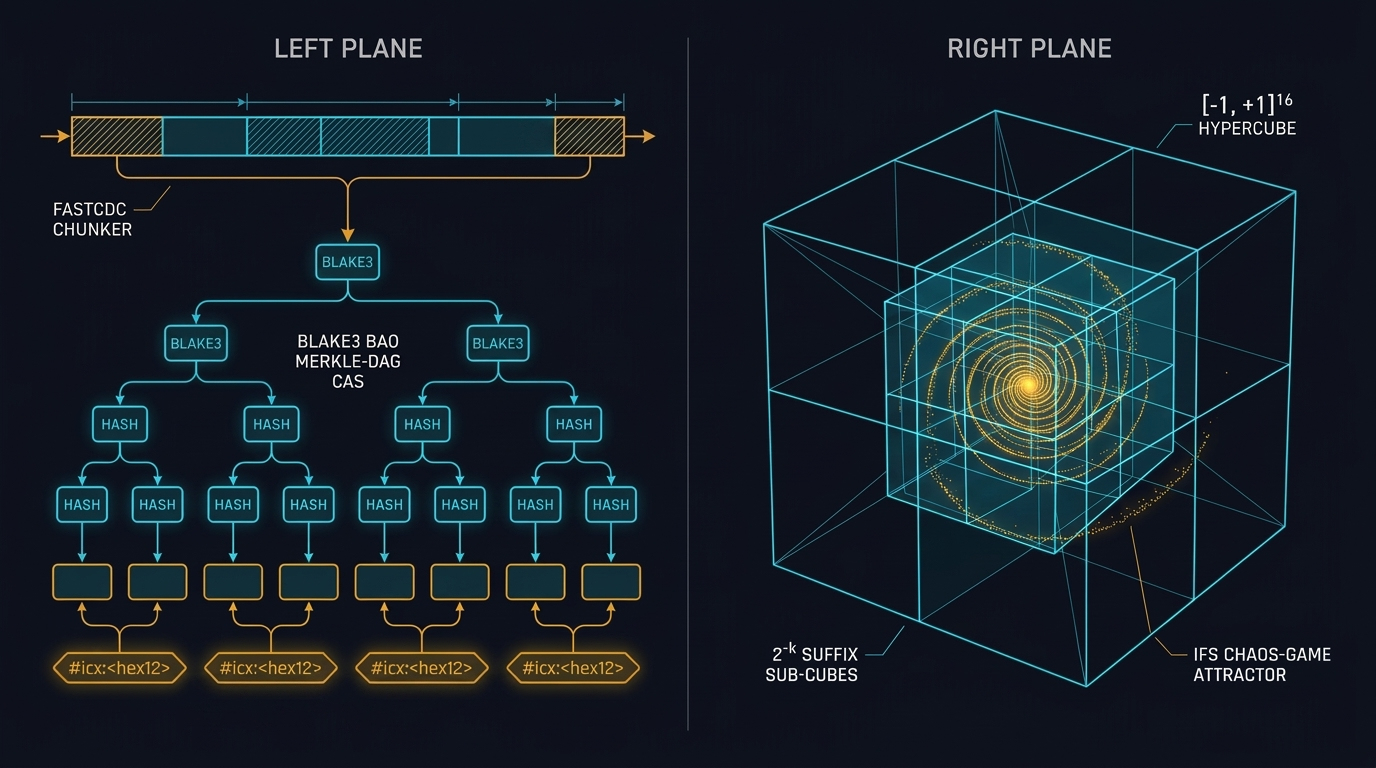
Figure 3.1: Dual-plane view of Infinity-Context: FastCDC + BLAKE3 Merkle-DAG Content-Addressed Storage (left) paired with the \([-1, +1]^{16}\) Contractive IFS Chaos-Game Attractor trajectory space with \(2^{-k}\) dyadic suffix sub-cubes (right).
2. Formal Mathematical Construction on \(([-1, +1]^{16}, d_\infty)\)¶
2.1 The Ambient Complete Metric Space¶
Let \(\mathcal{X} = [-1, +1]^{16} \subset \mathbb{R}^{16}\) denote the 16-dimensional origin-centered continuous hypercube (hexadekeract \(\gamma_{16}\), having \(2^{16} = 65,536\) extreme corner vertices \(V(\gamma_{16}) = \{-1, +1\}^{16}\)), equipped with the Chebyshev (\(L_\infty\)) metric:
- Completeness: Because \(\mathcal{X} = [-1, +1]^{16}\) is a closed and bounded subset of \(\mathbb{R}^{16}\), \((\mathcal{X}, d_\infty)\) is a complete metric space of diameter \(\operatorname{diam}_\infty(\mathcal{X}) = \max_{\vec{x},\vec{y} \in \mathcal{X}} \|\vec{x} - \vec{y}\|_\infty = 2.0\).
- Geometric Duality: Crucially, the closed ball of radius \(r\) around \(\vec{c}\) in the Chebyshev metric, \(B_\infty(\vec{c}, r) = \{\vec{z} \in \mathbb{R}^{16} : \|\vec{z} - \vec{c}\|_\infty \le r\}\), is itself a 16-dimensional axis-aligned sub-hypercube of side length \(2r\).
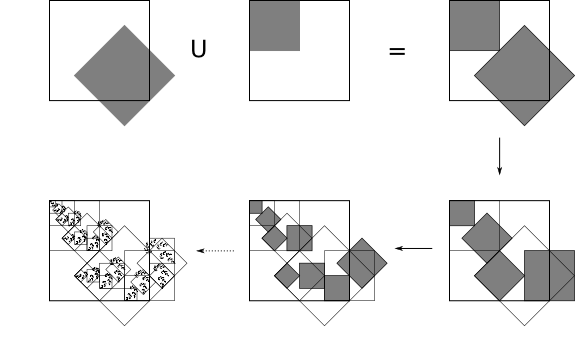
Banach Fixed-Point Contraction (Banach_Fixed_Point_Contraction.png) |
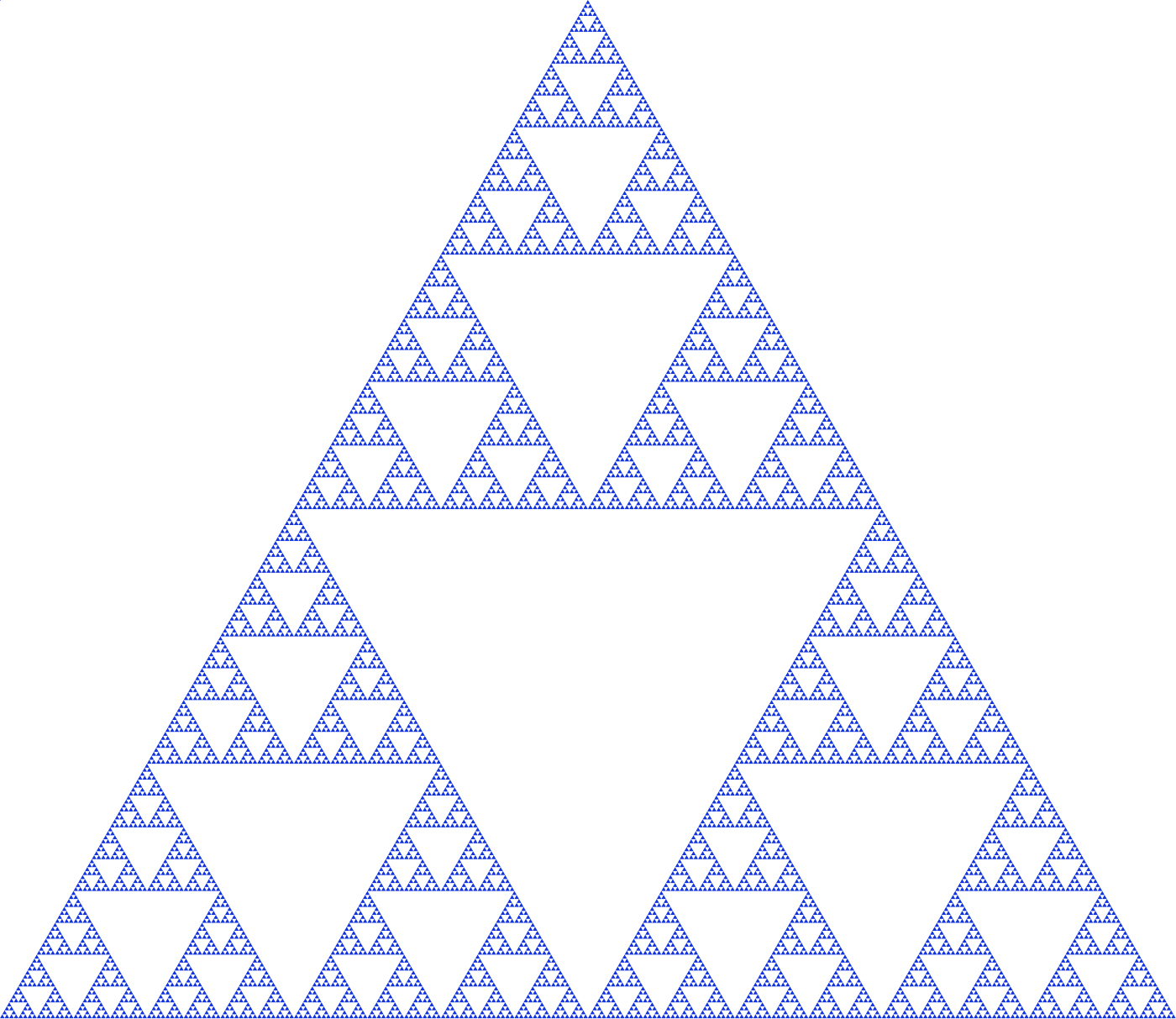
Sierpiński Chaos Game Attractor (Sierpinski_Chaos_Game.png) |
Square Chaos Game Quadrant Subdivision (Chaos_Game_square-EH-1.png) |
|---|---|---|
 |
 |
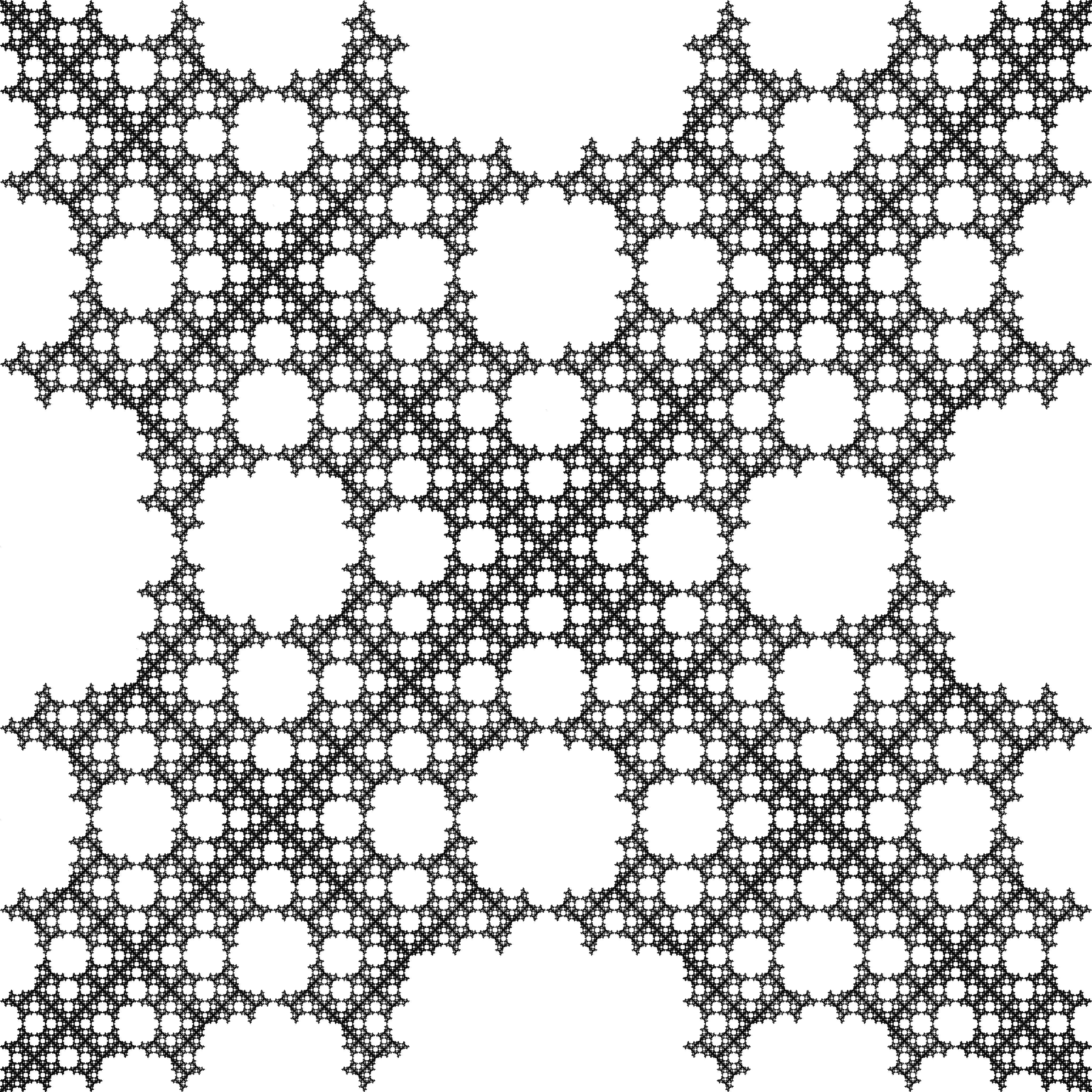 |
| Iterated contractive maps \(W(A) = \bigcup_i w_i(A)\) converging to the unique attractor | Contractive ratio \(L = 1/2\) toward vertices of a simplex | Contractive ratio \(L = 1/2\) toward vertices \(\{-1, +1\}^d\) of a hypercube (CGR) |
2.2 Block-Majority Corner Vertex Projection (\(\pi_{10240 \to 16}: Q_{10240} \to \{-1, +1\}^{16}\))¶
Given the 10,240-bit composite Hypervector \(H(s_t) \in \{0, 1\}^{10240}\) (words: [u64; 160]) of event \(s_t\), FractalCoord::corner_vertex (crates/icx-hdc/src/fractal.rs:29-41) partitions the 160 u64 words into 16 contiguous blocks of 10 words (640 bits per block) and extracts a 16-dimensional bipolar corner vertex \(\vec{v}(s_t) \in \{-1.0, +1.0\}^{16}\) by majority popcount:
#[inline]
pub fn corner_vertex(hv: &Hypervector) -> [f64; 16] {
    let mut v = [1.0f64; 16];
    for dim in 0..16 {
        let start = dim * 10;
        let mut ones = 0u32;
        for w in &hv.words[start..start + 10] {
            ones += w.count_ones();
        }
        // 10 words = 640 bits; threshold at 320
        v[dim] = if ones >= 320 { 1.0 } else { -1.0 };
    }
    v
}
2.3 Token-Driven Affine Contractive Maps & Banach Fixed-Point Proof¶
For each corner vertex \(\vec{v} \in \{-1, +1\}^{16}\), define the affine similarity map \(w_{\vec{v}}: \mathcal{X} \to \mathcal{X}\):
Theorem 3.1 (Strict Contractivity & Forward Invariance on \([-1, +1]^{16}\)):
- Forward Invariance: For any \(\vec{z} \in [-1, +1]^{16}\) and \(\vec{v} \in \{-1, +1\}^{16}\), every coordinate \(j \in \{0, \dots, 15\}\) satisfies: $\(|w_{\vec{v}}(\vec{z})_j| = \left|\frac{1}{2} z_j + \frac{1}{2} v_j\right| \le \frac{1}{2}|z_j| + \frac{1}{2}|v_j| \le \frac{1}{2}(1) + \frac{1}{2}(1) = 1 \implies w_{\vec{v}}(\mathcal{X}) \subseteq \mathcal{X}\)$
- Lipschitz Contraction Factor \(L = 0.5 < 1\): For any two points \(\vec{x}, \vec{y} \in \mathcal{X}\) and any fixed \(\vec{v} \in \{-1, +1\}^{16}\): $\(d_\infty\big(w_{\vec{v}}(\vec{x}), w_{\vec{v}}(\vec{y})\big) = \left\| \left(\frac{1}{2}\vec{x} + \frac{1}{2}\vec{v}\right) - \left(\frac{1}{2}\vec{y} + \frac{1}{2}\vec{v}\right) \right\|_\infty = \frac{1}{2}\|\vec{x} - \vec{y}\|_\infty = \frac{1}{2} d_\infty(\vec{x}, \vec{y})\)$ Similarly, in the Euclidean (\(L_2\)) metric: $\(d_2\big(w_{\vec{v}}(\vec{x}), w_{\vec{v}}(\vec{y})\big) = \left\| \frac{1}{2}(\vec{x} - \vec{y}) \right\|_2 = \frac{1}{2} d_2(\vec{x}, \vec{y})\)$
- Banach Fixed-Point Guarantee: By the Banach Contraction Mapping Theorem (Banach, 1922) and Hutchinson's Theorem (1981), each individual map \(w_{\vec{v}}\) has the unique fixed point \(\vec{z}^* = \vec{v}\) (\(\lim_{k \to \infty} w_{\vec{v}}^{\circ k}(\vec{z}_0) = \vec{v}\)), and the family \(\mathcal{F} = \{\mathcal{X}; w_{\vec{v}} : \vec{v} \in \{-1, +1\}^{16}\}\) defines a hyperbolic Iterated Function System whose Hutchinson operator \(\mathcal{W}(A) = \bigcup_{\vec{v}} w_{\vec{v}}(A)\) is a contraction of ratio \(L = \frac{1}{2}\) on the compact Hausdorff hyperspace \((\mathcal{H}(\mathcal{X}), d_{\text{Hausdorff}})\). \(\blacksquare\)
3. Trajectory Convergence & Proof of the \(O(1)\) Chebyshev Suffix Theorem¶
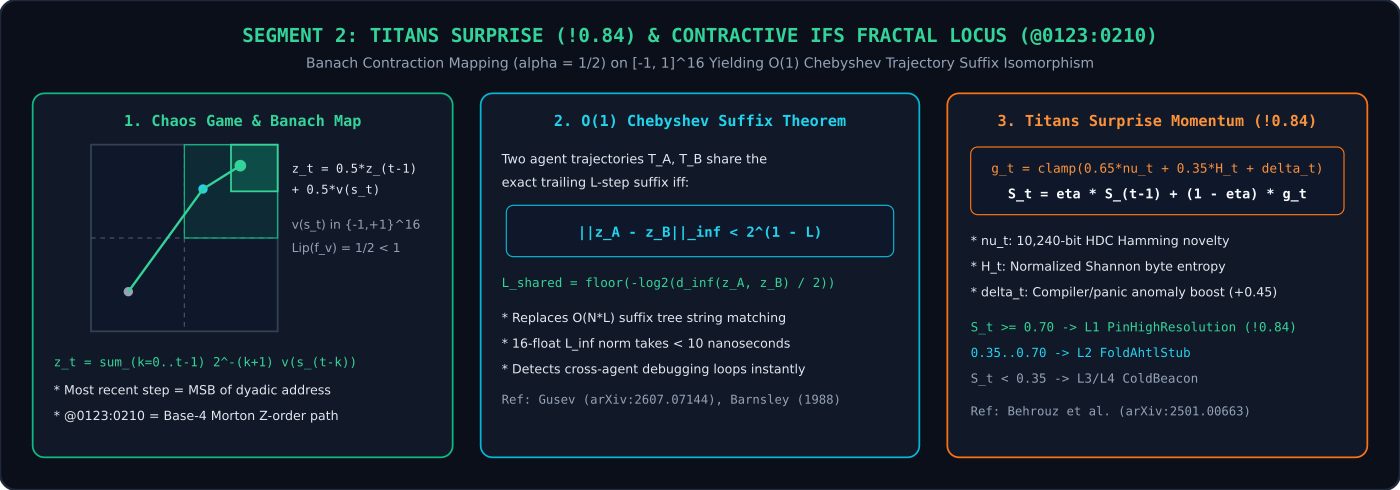
Figure 3.2: Contractive IFS trajectory recurrence, \(O(1)\) Chebyshev Suffix Theorem, and Titans Surprise momentum coupling (Vector SVG).
3.1 Unrolled Dyadic Series Expansion¶
Starting from the origin \(\vec{z}_0 = \vec{0} \in [-1, +1]^{16}\), a sequence of \(t\) agent state transitions \((s_1, s_2, \dots, s_t)\) updates the trajectory coordinate via FractalCoord::step (crates/icx-hdc/src/fractal.rs:46-56):
Observe the dyadic positional hierarchy of this expansion:
- The most recent transition \(s_t\) (\(k = 0\)) is weighted by \(2^{-1} = \frac{1}{2}\) and determines the sign (orthant) of every coordinate \(z_{t,j}\).
- The \(k\)-th most recent transition \(s_{t-k+1}\) determines the \(k\)-th most significant fractional bit of the signed dyadic expansion of \(z_{t,j}\)!
3.2 Theorem 3.2 (The \(O(1)\) Contractive Hypercube Suffix Theorem)¶
Statement: Let \(\vec{z}^{(A)} \in [-1, +1]^{16}\) (at depth \(t_A\)) and \(\vec{z}^{(B)} \in [-1, +1]^{16}\) (at depth \(t_B\)) be two FractalCoord trajectory states that share the exact same trailing \(K\) state corner vertices:
Then their Chebyshev (\(L_\infty\)) and Euclidean (\(L_2\)) distances satisfy the tight upper bounds:
Proof: Subtracting the unrolled series expansions of \(\vec{z}^{(A)}\) and \(\vec{z}^{(B)}\), the first \(K\) terms (\(k = 0, \dots, K-1\)) cancel identically:
For every coordinate \(j \in \{0, \dots, 15\}\) and every step \(k \ge K\) (where we define \(\vec{v} = \vec{0}\) for \(k \ge t\)), since \(v_j \in \{-1, 0, +1\}\), the coordinate difference is bounded by \(|v^{(A)}_j - v^{(B)}_j| \le 2\). By the triangle inequality:
Taking the maximum over \(j \in \{0, \dots, 15\}\) yields \(d_\infty(\vec{z}^{(A)}, \vec{z}^{(B)}) \le 2^{1 - K}\). And since \(\|\vec{u}\|_2 \le \sqrt{16}\,\|\vec{u}\|_\infty = 4\,\|\vec{u}\|_\infty\) on \(\mathbb{R}^{16}\), we immediately obtain \(d_2(\vec{z}^{(A)}, \vec{z}^{(B)}) \le 4 \cdot 2^{1 - K} = 2^{3 - K}\). \(\blacksquare\)
3.3 \(O(1)\) Upper-Bound Shared Suffix Heuristic (shared_suffix_depth)¶
Normalizing \(d_\infty(\vec{z}^{(A)}, \vec{z}^{(B)})\) by the hypercube radius (\(\frac{1}{2}\operatorname{diam}_\infty(\mathcal{X}) = 1.0\)) gives \(d_{\text{norm}} = \frac{1}{2} d_\infty(\vec{z}^{(A)}, \vec{z}^{(B)}) \le 2^{-K}\). Because Theorem 3.2 establishes an upper bound on \(d_\infty\) (whereas distinct alternating trajectories such as \([-1, +1]\) vs. \([+1, -1]\) can yield \(|0.25 - (-0.25)| = 0.5 = 2^{-1}\) without sharing their final vertex), inverting via \(-\log_2(\cdot)\) provides a fast \(O(1)\) upper-bound suffix-depth estimator / proximity heuristic (crates/icx-hdc/src/fractal.rs:75-85). When exact suffix identity is required, callers pair shared_suffix_depth with quadrant_signature_u16() orthant equality or trailing state-ID verification:
#[inline]
pub fn shared_suffix_depth(&self, other: &Self) -> u32 {
    let d_norm = self.chebyshev_distance(other) * 0.5;
    if d_norm <= 0.0 {
        return self.depth.min(other.depth).min(32);
    }
    if d_norm >= 1.0 {
        return 0;
    }
    let k = (-d_norm.log2()).floor() as u32;
    k.min(self.depth).min(other.depth).min(32)
}
4. Fixed-Point Wire Serialization (fc:<64-hex>, [i16; 16]) & Quadrant Signatures¶
To serialize a 16-dimensional FractalCoord into the compact 256-bit fc:<64-hex> wire field (and the 32-byte frac_q15: [i16; 16] slot in the /dev/shm Seqlock ring buffer), AHTL v1.0 supports two fixed-point quantizations alongside f64 internal accumulators:
| Representation | Rust Type | Scale Factor | Dynamic Range | Resolution (\(\Delta z\)) | Max Suffix Depth | Usage in icx |
|---|---|---|---|---|---|---|
| IEEE-754 Double | [f64; 16] (128 B) |
\(1.0\) | \([-1.0, +1.0]\) | \(2^{-53} \approx 1.11 \times 10^{-16}\) | \(32\) steps (capped) | In-memory FractalCoord in icx-hdc |
Signed Q15 |
[i16; 16] (32 B) |
\(32\,767 = 2^{15}-1\) | \([-1.0, +1.0]\) | \(2^{-15} \approx 3.05 \times 10^{-5}\) | \(15\) steps | FractalCoord::to_q15() for /dev/shm & fc:<64-hex> |
Signed Q1.14 |
[i16; 16] (32 B) |
\(16\,384 = 2^{14}\) | \([-2.0, +1.99994]\) | \(2^{-14} \approx 6.10 \times 10^{-5}\) | \(14\) steps (exact shift) | Bit-exact right-shift (z >> 1) + (v << 13) arithmetic |
| Orthant Mask | u16 (2 B) |
Sign bit \(\mathbb{I}(z_j \ge 0)\) | \(\{0, 1\}^{16}\) | \(1.0\) (Top orthant) | \(1\) step (\(65,536\) bins) | quadrant_signature_u16() in Braille Channel B (B[4..5]) |
4.1 fc:<64-hex> Wire Encoding & Decoding¶
Each of the 16 signed 16-bit coordinates \(q_j \in \text{i16}\) (j = 0..16) is formatted as 4 lowercase big-endian hexadecimal digits ({:04x} on q_j as u16), producing a deterministic 64-character hexadecimal string: