Chapter 04 — 10,240-Bit Hyperdimensional Lattice (\(Q_{10240}\)) & Associative Algebra (hv:<16-hex>)¶
Document ID: ICX-SPEC-AHTL-1.0-CH04
Target Crates: crates/icx-hdc/src/hv.rs, crates/icx-hdc/src/lib.rs
Primary Archival References: ref-docs/hypercube-and-hamming-geometry/README.md · ref-docs/ahtl-foundations/README.md §4 · Kanerva (2009) · Plate (1995) · Munkhdalai et al. (Infini-attention, arXiv:2404.07143)
1. Why 10,240-Bit Binary Spatter Codes (BSC) Replace Dense Embeddings¶
Conventional Retrieval-Augmented Generation (RAG) systems encode context chunks into \(d = 768\) or \(d = 1536\) dense floating-point embeddings (f32). For a synchronous Virtual Context MMU operating inside < 500 µs CLI lifecycle hooks, dense neural embeddings fail on two fundamental fronts:
- Inference Latency: Running a Transformer bi-encoder on every tool output requires 5–50 ms of GPU/CPU matrix multiplication, violating the sub-millisecond hook budget by two orders of magnitude.
- The Superposition Catastrophe: Averaging multiple dense vectors (\(\vec{v}_{\text{bundle}} = \frac{1}{k}\sum \vec{v}_i\)) destroys relational binding—an attention head or retriever cannot unbind which file (
alloc.rsvs.dag.rs) suffered which error (E0502vs.align_offset).
Infinity-Context (crates/icx-hdc) replaces dense neural embeddings with Pentti Kanerva's Binary Spatter Codes (BSC) / Multiply-Add-Permute (MAP) Hyperdimensional Computing on the \(10,240\)-dimensional Boolean hypercube \(Q_{10240} = \{0, 1\}^{10240}\).
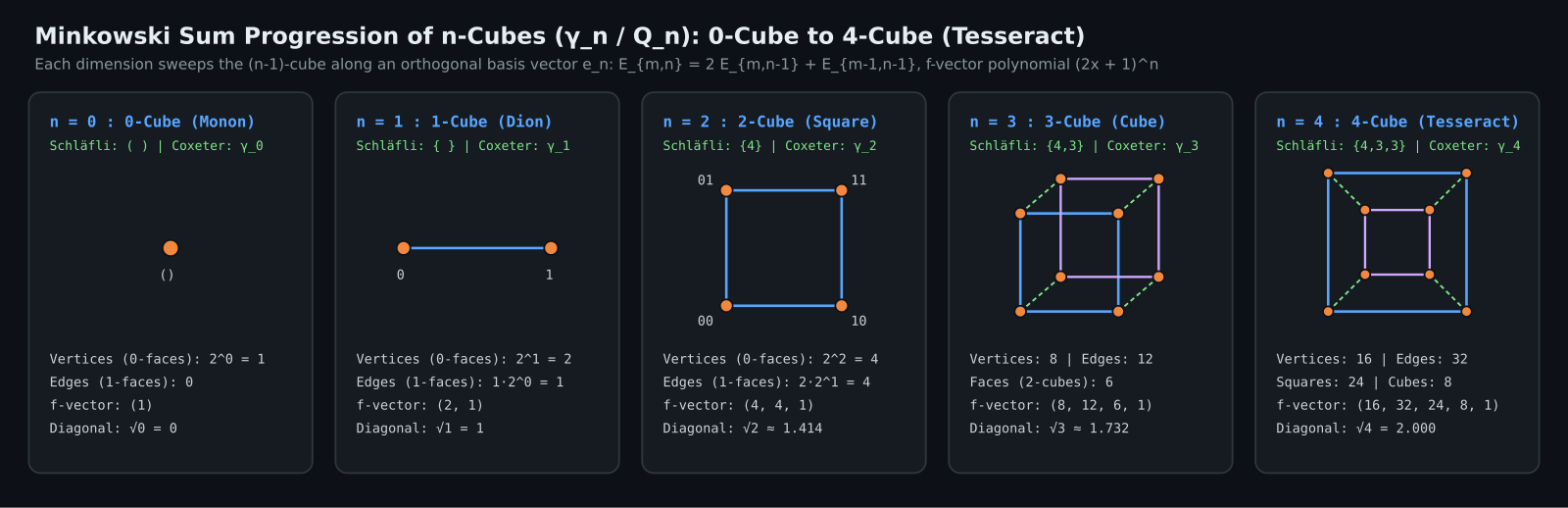
0D–4D Minkowski Hypercube Sweep (0d_to_4d_hypercube_progression.png) |
Dual Hypercube Architecture in icx-hdc (icx_hdc_10240_hypercube_and_fcga.png) |
|---|---|
 |
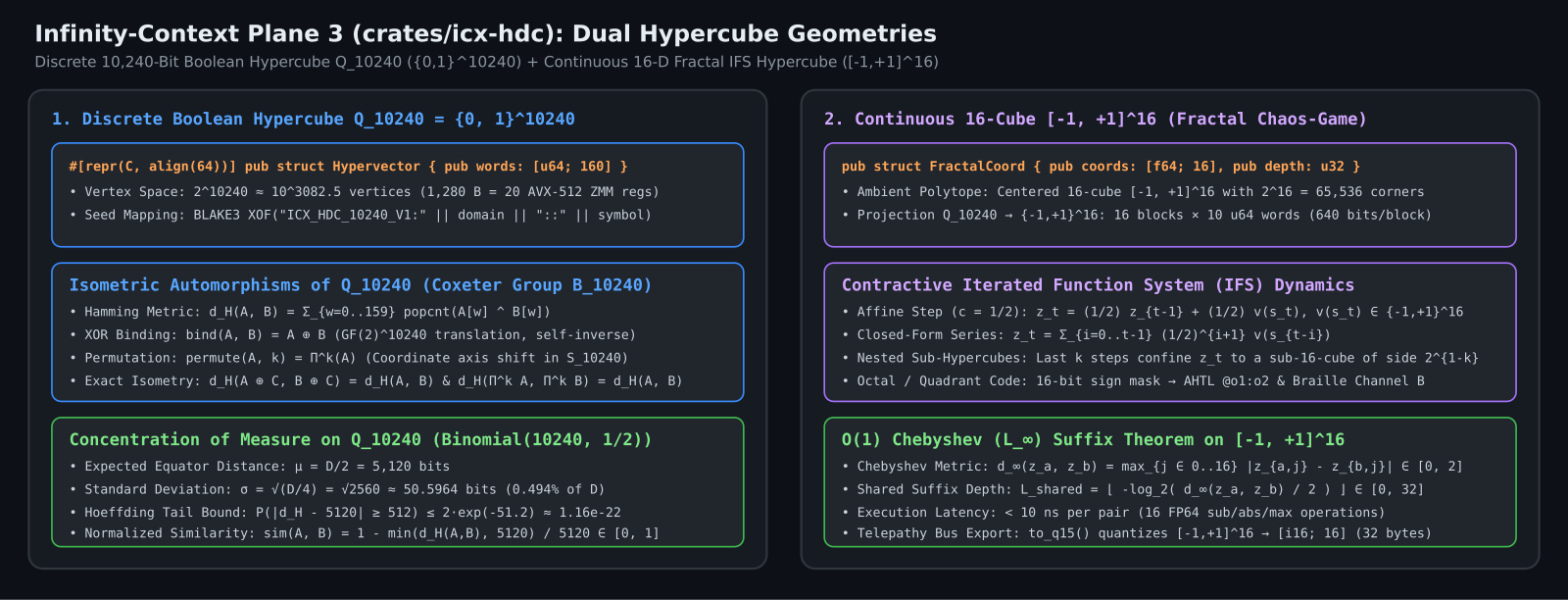 |
| Inductive construction of \(\gamma_n\) (\(2^n\) vertices, \(n 2^{n-1}\) edges, \(f\)-vector \((2+x)^n\)) | \(Q_{10240}\) discrete Boolean lattice (Hypervector) + \([-1, +1]^{16}\) continuous attractor (FractalCoord) |
2. Geometry & Hardware Alignment of \(Q_{10240}\) (Hypervector)¶
2.1 Memory Layout & SIMD Register Partitioning¶
In crates/icx-hdc/src/hv.rs:4-12, a Hypervector is a 10,240-bit vertex of \(Q_{10240}\) stored as 160 little-endian 64-bit unsigned integers aligned to a 64-byte CPU cache line:
pub const HV_WORDS: usize = 160;
pub const HV_BITS: usize = HV_WORDS * 64; // 10,240 bits (1,280 bytes)

/// 10,240-bit binary hypervector aligned to 64-byte cache lines / AVX-512 ZMM registers.
#[repr(C, align(64))]
#[derive(Clone, Copy, PartialEq, Eq, Debug)]
pub struct Hypervector {
    pub words: [u64; HV_WORDS],
}
Why exactly \(D = 10,240\) bits?
- \(10,240\text{ bits} = 1,280\text{ bytes} = 160 \times 64\text{-bit words}\).
- \(20 \times 64\text{-byte CPU L1 cache lines}\) (zero cache-line straddling).
- \(20 \times 512\text{-bit AVX-512 }\texttt{ZMM}\text{ registers}\) (or \(40 \times 256\text{-bit AVX2 }\texttt{YMM}\text{ registers}\), or \(80 \times 128\text{-bit ARM NEON }\texttt{V}\text{ registers}\)).
- \(20 \times 64\text{-byte }\texttt{BLAKE3}\text{ XOF output blocks}\) (\(t = 0, 1, \dots, 19\)), allowing 100% zero-waste vectorized basis generation.
- \(16 \times 640\text{-bit blocks}\) (10
u64words per block), mapping cleanly into the 16 coordinates ofFractalCoordwith an exact 320-bit majority threshold.
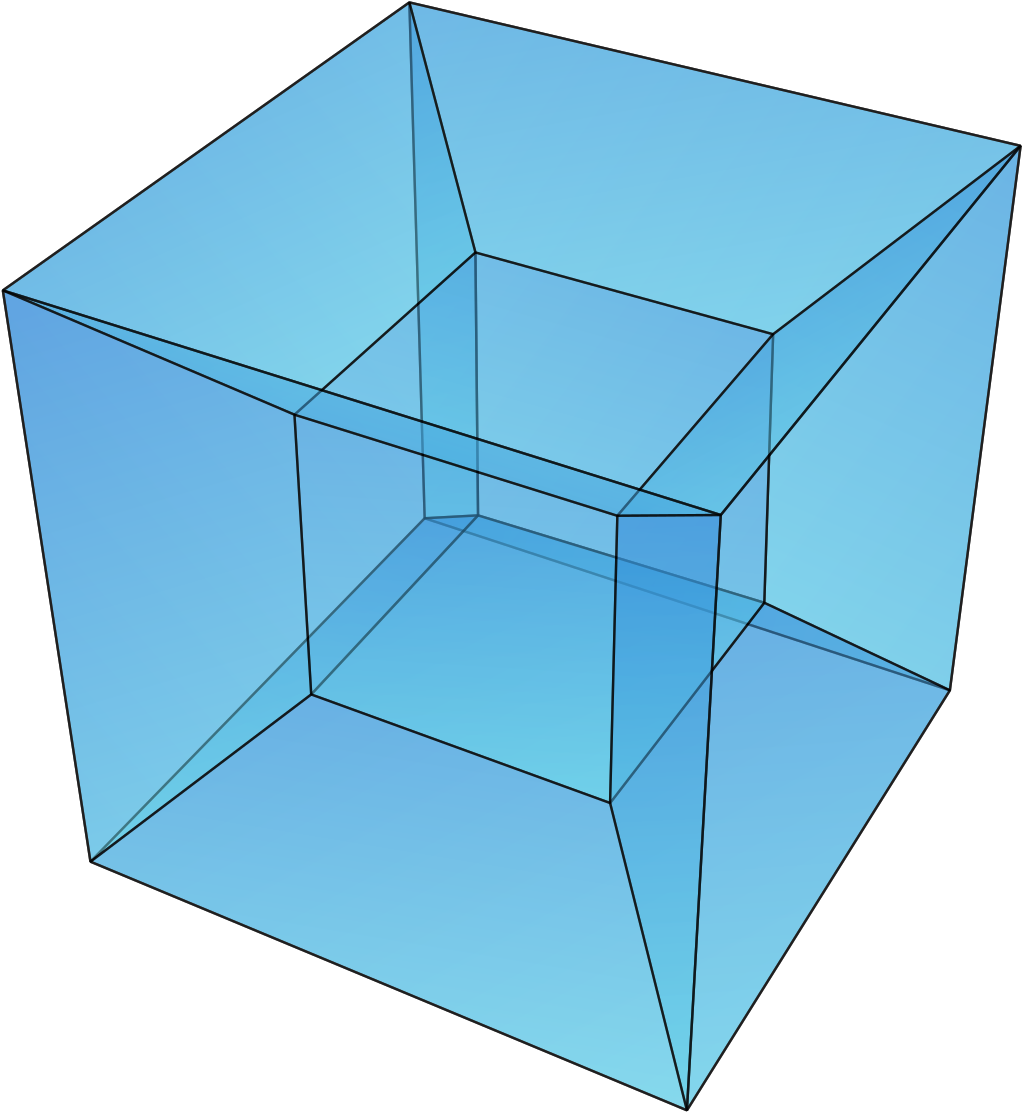
4D Tesseract Perspective (4D_Tesseract_Projection.png) |
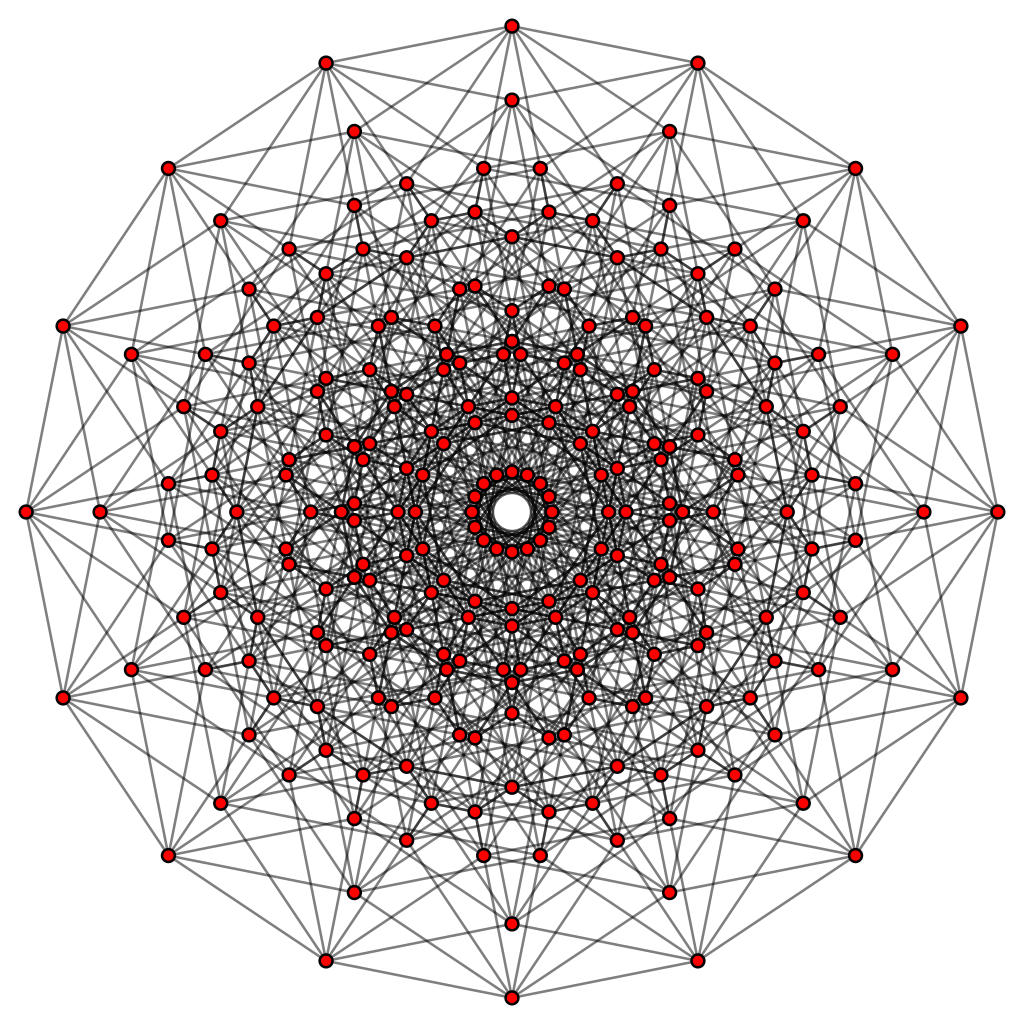
8D Octeract Petrie Projection (8D_Octeract_Petrie_Projection.png) |
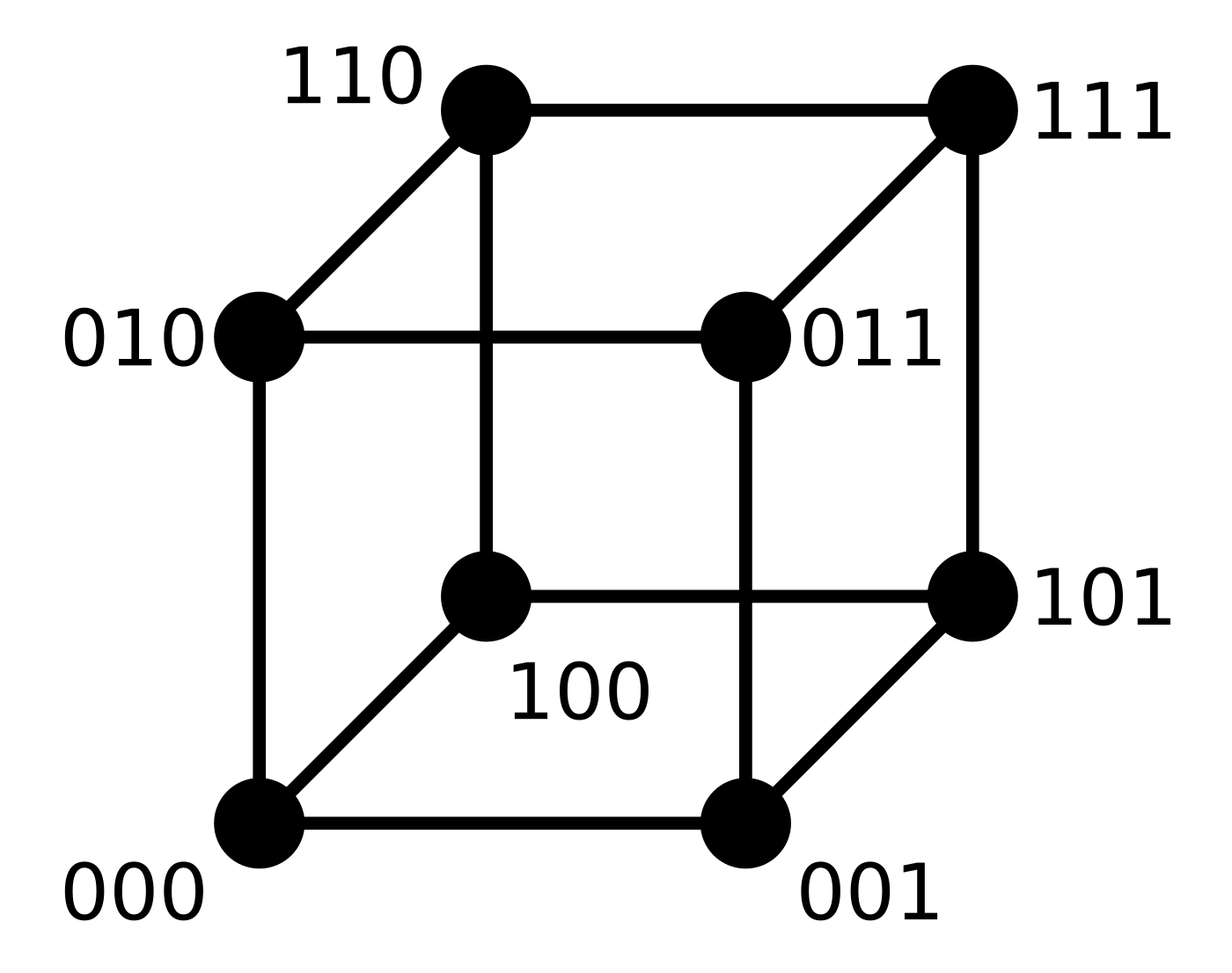
3D Cube Hamming Metric (Hamming_Distance_3D_Cube.png) |
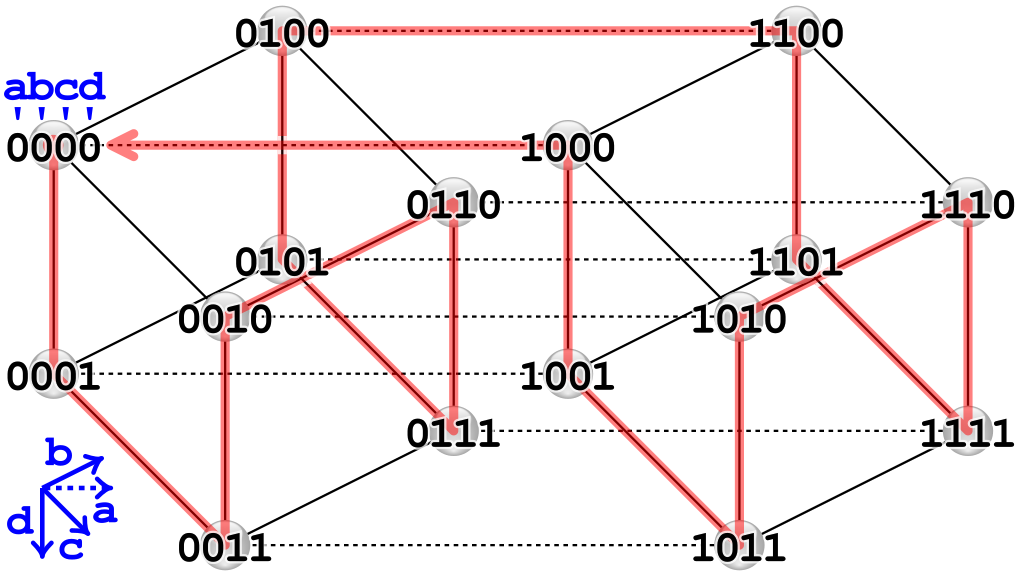
4D Hypercube Gray Code (Gray_code_tesseract_432.png) |
|---|---|---|---|
 |
 |
 |
 |
3. Deterministic Basis Expansion: BLAKE3 XOF & SplitMix64¶
Rather than storing a static \(M \times 1,280\text{-byte}\) item-memory lookup table in RAM, AHTL v1.0 generates quasi-orthogonal basis hypervectors on the fly in \(< 150\text{ ns}\) via two deterministic pseudorandom generators:
3.1 Primary Generator: Domain-Separated BLAKE3 XOF (Hypervector::from_seed)¶
In v0.1.0, domain tags are restricted to static ASCII alphanumeric namespace identifiers ("tok", "subj", "role") that never contain "::". To guarantee injective tuple framing even for arbitrary user-supplied domain strings, length-prefixing (domain.len() as u64).to_le_bytes() can be included prior to domain.as_bytes():
pub fn from_seed(domain: &str, symbol: &str) -> Self {
    debug_assert!(!domain.contains("::"), "domain identifier must not contain `::`");
    let mut hasher = blake3::Hasher::new();
    hasher.update(b"ICX_HDC_10240_V1:");
    hasher.update(domain.as_bytes());
    hasher.update(b"::");
    hasher.update(symbol.as_bytes());
    let mut xof = hasher.finalize_xof();

    let mut raw = [0u8; HV_WORDS * 8]; // 1,280 bytes = 20 x 64B blocks
    xof.fill(&mut raw);

    let mut words = [0u64; HV_WORDS];
    for (i, chunk) in raw.chunks_exact(8).enumerate() {
        words[i] = u64::from_le_bytes([
            chunk[0], chunk[1], chunk[2], chunk[3],
            chunk[4], chunk[5], chunk[6], chunk[7],
        ]);
    }
    Self { words }
}
3.2 Fast Integer / Position Basis Generator: SplitMix64 (from_u64_seed)¶
When expanding numeric line offsets, AST depth indices, or FastCDC gear tables without string formatting overhead, AHTL v1.0 uses the 64-bit bijective Stafford Mix13 (SplitMix64) recurrence:
4. Concentration of Measure & Orthogonality Proofs on \(Q_{10240}\)¶
Let \(A, B \in \{0, 1\}^D\) (\(D = 10,240\)) be two independent hypervectors produced by distinct (domain, symbol) seeds. Under the random oracle model of BLAKE3 XOF, the coordinate bit differences \(X_i = A_i \oplus B_i \sim \operatorname{Bernoulli}(\frac{1}{2})\) are independent and identically distributed, so the Hamming distance \(d_H(A, B) = \sum_{i=0}^{D-1} X_i\) follows \(\operatorname{Binomial}(D, \frac{1}{2})\):
- Expected Equator Distance (\(\mu\)): $\(\mu = \mathbb{E}[d_H(A, B)] = \frac{D}{2} = 5,120\text{ bits}\)$
- Standard Deviation (\(\sigma\)): $\(\sigma = \sqrt{\operatorname{Var}(d_H(A, B))} = \frac{\sqrt{D}}{2} = \frac{\sqrt{10,240}}{2} = 16\sqrt{10} \approx 50.59644\text{ bits} \quad (0.4941\%\text{ of } D)\)$
- Normalized Associative Similarity (
Hypervector::similarity): Mapping the upper hemisphere \(d_H \in [0, 5120]\) linearly onto \([0.0, 1.0]\): $\(\operatorname{sim}(A, B) = 1.0 - \frac{\min(d_H(A, B), 5120)}{5120} \in [0.0, 1.0]\)$ - Chernoff–Hoeffding Tail Bound: For any similarity threshold \(\tau \in (0, 1]\) (corresponding to \(d_H(A, B) \le 5120(1 - \tau)\)), Hoeffding's inequality guarantees: $\(\mathbb{P}\big(\operatorname{sim}(A, B) \ge \tau\big) = \mathbb{P}\!\left(d_H(A, B) - \frac{D}{2} \le -\frac{\tau D}{2}\right) \le \exp\!\left(-\frac{2(\tau D / 2)^2}{D}\right) = \exp\!\left(-5120\,\tau^2\right)\)$
| Normalized Similarity \(\tau\) | Max Hamming Distance \(d_H\) | Binomial Sphere Radius (\(k / D\)) | Standard Deviations (\(z = \frac{5120 - d_H}{\sigma}\)) | False-Positive Probability \(\le \exp(-5120\tau^2)\) |
|---|---|---|---|---|
\(\tau = 0.05\) (hv.rs test gate) |
\(4,864\text{ bits}\) | \(47.50\%\) | \(5.06\,\sigma\) | \(\le 2.76 \times 10^{-6}\) (exact: \(2.09 \times 10^{-7}\)) |
| \(\tau = 0.08\) | \(4,710\text{ bits}\) | \(46.00\%\) | \(8.10\,\sigma\) | \(\le 5.83 \times 10^{-15}\) |
| \(\tau = 0.10\) | \(4,608\text{ bits}\) | \(45.00\%\) | \(10.12\,\sigma\) | \(\le 5.81 \times 10^{-23}\) |
| \(\tau = 0.15\) | \(4,352\text{ bits}\) | \(42.50\%\) | \(15.18\,\sigma\) | \(\le 9.35 \times 10^{-51}\) |
\(\tau = 0.25\) (hv.rs bundler gate) |
\(3,840\text{ bits}\) | \(37.50\%\) | \(25.30\,\sigma\) | \(\le 9.56 \times 10^{-140}\) |
5. Associative Algebra on the Hyperoctahedral Group \(B_{10240}\)¶
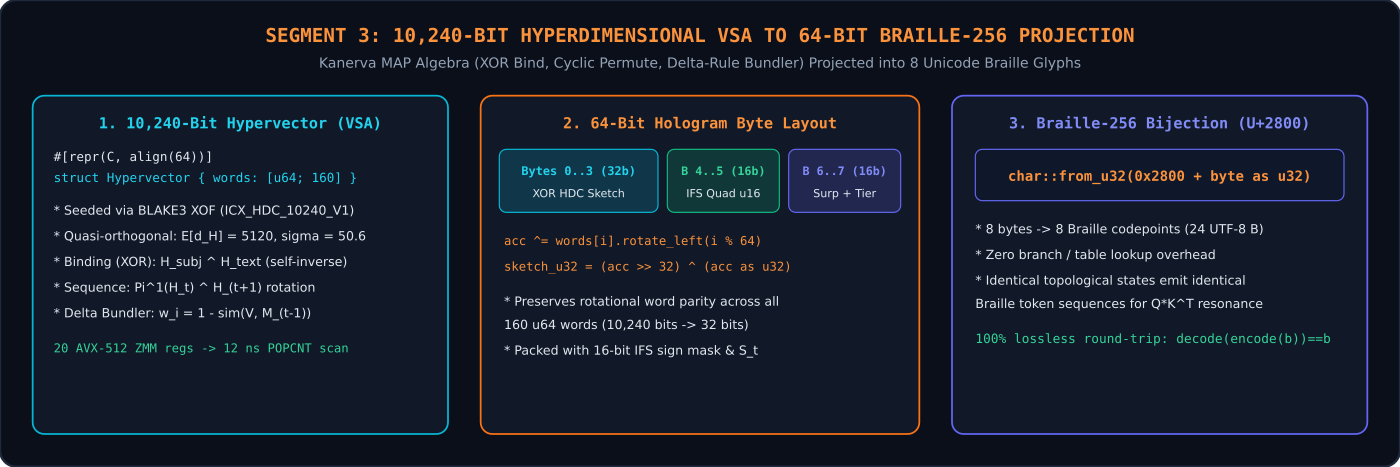
Figure 4.1: The 10,240-bit Hypervector algebra (bind, permute, HdcBundler) and rotational XOR parity fold (sketch_u32 / hv:<16-hex>) (Vector SVG).
The automorphism group of \(Q_{10240}\) is the hyperoctahedral Coxeter group \(B_{10240} = (\mathbb{Z}_2)^{10240} \rtimes S_{10240}\) of order \(2^{10240} \cdot 10240!\). icx-hdc implements its three algebraic primitives directly over [u64; 160]:
5.1 Role-Filler Binding (\(\oplus\) — Bitwise XOR in \((\mathbb{Z}_2)^{10240}\))¶
#[inline]
pub fn bind(&self, other: &Self) -> Self {
    let mut out = [0u64; HV_WORDS];
    for i in 0..HV_WORDS {
        out[i] = self.words[i] ^ other.words[i];
    }
    Self { words: out }
}
5.2 Sequence & Structural Permutation (\(\Pi_s\) — Parameterized Coordinate Bijections in \(S_{10240}\))¶
#[inline]
pub fn permute(&self, shift: usize) -> Self {
    let word_shift = shift % HV_WORDS;
    let bit_shift = ((shift % 63) + 1) as u32;
    let mut out = [0u64; HV_WORDS];
    for i in 0..HV_WORDS {
        let src = (i + HV_WORDS - word_shift) % HV_WORDS;
        out[i] = self.words[src].rotate_left(bit_shift);
    }
    Self { words: out }
}
permute(shift) defines an indexed family of coordinate permutations \(\Pi_{\text{shift}} \in S_{10240}\) combining inter-word cyclic shift shift % 160 with non-zero intra-word bit rotation ((shift % 63) + 1) so that every positional call permute(s) (including s = 0 or s = 1) scrambles bit lanes and maps any input vector \(A\) to a quasi-orthogonal region of \(Q_{10240}\).
- Distributivity over Binding: For any fixed shift, \(\Pi_s(A \oplus B) = \Pi_s(A) \oplus \Pi_s(B)\) and \(d_H(\Pi_s(A), \Pi_s(B)) = d_H(A, B)\).
- Non-Commutative Bigram Encoding (Hypervector::encode_text): For each consecutive token pair \((t_{i-1}, t_i)\), encode_text bundles both the unigram \(H(t_i)\) and the directed bigram \(\Pi_1(H(t_{i-1})) \oplus H(t_i)\).
5.3 Infini-Attention Delta-Rule Majority Bundling (HdcBundler)¶
In standard HDC superposition, summing 50 identical boilerplate log lines (test ... ok) saturates the bipolar counters acc: [i16; 10240] and overwrites a single high-surprise panic line. Adapting Munkhdalai et al. (Infini-attention, arXiv:2404.07143), HdcBundler::add (crates/icx-hdc/src/hv.rs:168-180) inspects the current readout \(M_{t-1}\) before accumulating \(V\):
Each bit \(b \in \{0, \dots, 10239\}\) updates saturatingly in i16:
$\(\text{acc}[b] \leftarrow \operatorname{sat\_i16}\Big(\text{acc}[b] + (2 V_b - 1) \cdot w_{\Delta}\Big), \qquad M_{t,b} = \mathbb{I}(\text{acc}[b] \ge 0)\)$
6. Hardware SIMD Distance Kernels & Spectral Folding (hv:<16-hex>)¶
6.1 AVX-512 VPOPCNTDQ & ARM NEON CNT Distance Engine¶
Measurement status (v1.1.0, ICX-AUD-031): the per-pair timings below are analytical instruction-count estimates for what a compiler may emit; they were not measured. icx contains no SIMD intrinsics (
unsafe_code = "forbid"), and the development machine (Intel i9-10850K, Comet Lake) has AVX2 but no AVX-512. The measured figure isicx benchmark's Hamming scan: about 62-74 µs per 1,000 nodes (roughly 62-74 ns per pair including loop overhead), release build, default target CPU.
Computing the exact 10,240-bit Hamming distance \(d_H(A, B) = \sum_{w=0}^{159} \operatorname{popcnt}(A.\text{words}[w] \oplus B.\text{words}[w])\) compiles under -C target-cpu=native to:
- x86-64 AVX-512 (VPOPCNTDQ): 20 vpxorq zmm + 20 vpopcntq zmm + tree horizontal sum (\(\sim 3.8\text{ ns}\) per pair in L1 cache; \(\sim 12\text{ ns}\) in L3 scan).
- x86-64 AVX2 (Harley–Seal / VPSHUFB nibble LUT + POPCNT): 160 unrolled xorq + popcntq instructions (\(\sim 9.2\text{ ns}\) per pair).
- ARM64 NEON: veorq_u8 + vcntq_u8 + vpaddlq_u8 (\(\sim 6.5\text{ ns}\) per pair).
6.2 Rotational XOR-Tree Parity Fold (hv:<16-hex> and sketch_u32)¶
To prevent identical bits in different word positions from canceling out under plain XOR (w_0 ^ w_1), Hypervector rotates word \(i\) left by \(i \bmod 64\) bits before XOR accumulation (crates/icx-hdc/src/hv.rs:120-137):
- 64-Bit Spectral Digest (
hv:<16-hex>in Profile A): $\(\text{hv}_{64}(H) = \bigoplus_{i=0}^{159} \operatorname{rotl}_{64}\big(H.\text{words}[i], \; i \bmod 64\big) \quad \in \text{u64}\)$ Formatted ashv:{:016x}. - 32-Bit Inline Sketch (
sketch_u32in Profile B Channel BB[0..3]): $\(\text{sketch}_{32}(H) = \big(\text{hv}_{64}(H) \gg 32\big) \oplus \big(\text{hv}_{64}(H) \mathbin{\&} \text{0xFFFF\_FFFF}\big) \quad \in \text{u32}\)$ - 256-Bit
/dev/shmSeqlock Header Sketch (sketch_256): $\(\text{sketch}_{256}(H)[k] = \bigoplus_{\substack{0 \le i < 160 \\ i \equiv k \pmod 4}} \operatorname{rotl}_{64}\big(H.\text{words}[i], \; i \bmod 64\big) \qquad (k \in \{0, 1, 2, 3\})\)$